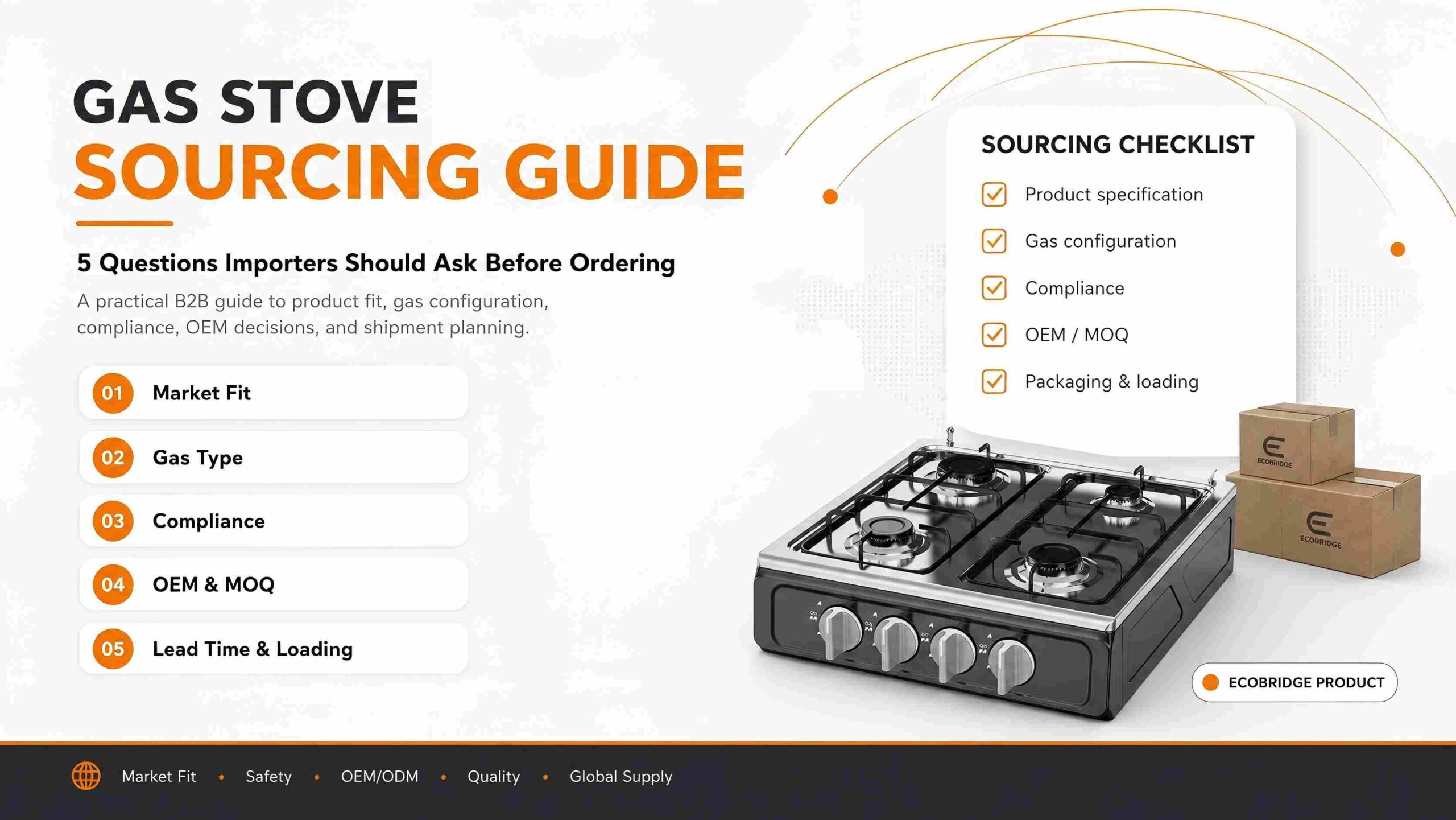
Gas Stove Sourcing Guide: 5 Questions Importers Should Ask Before Ordering
Sourcing gas stoves for wholesale is not simply about finding a model, comparing factory prices, and placing an order.
For importers, distributors, appliance wholesalers, retailers, and private-label brands, the right gas stove depends on several factors: the destination market, gas type, burner configuration, product positioning, local requirements, customization needs, packaging, production lead time, and container efficiency.
A gas stove that works well in one market may require a different configuration for another country. Even two products that look almost identical can differ in burner systems, gas pressure requirements, valves, ignition components, materials, packaging, testing requirements, and production cost.
Dit Gids voor de aankoop van gasfornuizen answers five important questions wholesale buyers should discuss with a manufacturer before approving samples or placing a bulk order.
Snelle antwoorden voor importeurs van gasfornuizen
| Question | Snel antwoord |
|---|---|
| How do I choose the right gas stove? | Start with the destination country, target customer, gas type, burner quantity, materials, features, and retail price positioning. |
| Should I choose LPG or natural gas? | Confirm the gas supply and operating requirements of the destination market before approving production. |
| What certifications and tests are required? | Requirements vary by country and product configuration. Confirm applicable regulations, testing, labeling, and documentation before mass production. |
| Can gas stoves be customized for my brand? | Yes. OEM projects can include logos, packaging, colors, panels, knobs, labels, manuals, burner configurations, and other product details. |
| What should I confirm before placing a bulk order? | Confirm MOQ, samples, final specifications, lead time, packaging, inspection requirements, carton dimensions, and container-loading quantity. |
These five questions provide a more reliable way to compare gas stove manufacturers than looking at unit price alone.
1. How Do I Choose the Right Gas Stove Specification for My Market?
The right gas stove should be selected according to the destination market, target customer, gas type, burner quantity, product size, materials, cooking habits, retail price position, and applicable local requirements. There is no single gas stove configuration that is suitable for every market.
This should usually be the first discussion between an importer and a gas stove manufacturer.
A request such as:
“Please quote your best four burner gas stove.”
does not provide enough information for an accurate product recommendation.
Two four-burner gas stoves can look similar while using different burners, valves, pan supports, ignition systems, body materials, control knobs, packaging methods, and internal components.
Before comparing prices, buyers should first define what type of product their market actually needs.
Begin met het land van bestemming
Tell the manufacturer where the gas stove will be sold.
The destination market can influence:
- Gasconfiguratie
- Werkdruk
- Burner preferences
- Afmetingen van het product
- Safety requirements
- Productetiketten
- Gebruiksaanwijzingen
- Packaging language
- Certificeringseisen
- Prijspositionering in de detailhandel
- Customer expectations
A product manufactured for one country should not automatically be assumed to suit another market.
Providing the destination country early allows the factory to narrow the product range and discuss the correct configuration before quotation and sampling.
Define Your Target Customer
Different customer groups require different products.
A distributor supplying price-sensitive retail stores may need a different product from a private-label brand targeting middle- or higher-end appliance stores.
Before selecting a model, define whether the product will be positioned as:
- Economy
- Mainstream
- Middenklasse
- Premium
- Draagbaar
- Tafelblad
- Freestanding
- Residential
- Retail
- Project supply
This allows the manufacturer to recommend materials, components, packaging, and product features that match the intended market.
Which Burner Quantity Should You Choose?
Gas stoves are available in different burner configurations, and the right choice depends on the needs of the target market.
A gasfornuis met één brander provides a compact cooking solution for markets where portability, small size, or simple cooking functions are important.
A gasfornuis met twee pitten offers two cooking positions while maintaining a relatively compact body.
A gasfornuis met drie pitten provides additional cooking capacity without immediately moving to a larger four- or five-burner format.
A gasfornuis met vier branders provides more simultaneous cooking positions and may suit buyers looking for a broader household cooking platform.
A gasfornuis met vijf branders offers additional cooking flexibility and can support larger or more feature-oriented product ranges.
However, burner count alone should never determine the purchasing decision.
Importers should also compare:
- Afmetingen van de branders
- Afstand tussen de branders
- Eisen aan het verwarmingsvermogen
- Ontwerp met pan-ondersteuning
- Afmetingen van de carrosserie
- Indeling van de bedieningselementen
- Ontstekingssysteem
- Oppervlaktemateriaal
- Adviesprijs
Reviewing different burner configurations helps buyers identify which format is more appropriate for their target customer and market position.
Prepare a Product Brief Before Requesting a Quotation
A simple sourcing brief can significantly improve the quality of the manufacturer’s recommendation.
Include:
Land van bestemming:
Where the gas stove will be imported and sold.
Gas requirement:
LPG, natural gas, or another specified gas configuration.
Burner quantity:
One, two, three, four, or five burners.
Product type:
Tabletop gas stove, gas cooktop, gas range, or another format.
Material preference:
For example, painted steel, stainless steel, tempered glass, or another available material.
Target customer:
Economy, mainstream, mid-range, or premium.
Estimated quantity:
Trial order, mixed container, or full-container purchase.
Branding requirements:
Factory brand, private label, or OEM.
A detailed brief allows the manufacturer to recommend suitable models instead of simply sending a large catalog.
2. Should I Order LPG or Natural Gas Gas Stoves?
Importers should confirm the intended gas type and operating requirements before approving a gas stove for production. LPG and natural gas can require different injectors, adjustments, labels, testing conditions, and other product specifications.
Gas type is one of the most important technical details in international gas stove sourcing.
A gas stove should not be selected based only on its appearance, burner quantity, and factory price.
Why Does Gas Type Matter?
Different markets use different gas supply systems.
Depending on the product and destination country, the manufacturer may need to confirm:
- Gascategorie
- Werkdruk
- Injector or nozzle specification
- Burner adjustment
- Kleppenconfiguratie
- Vereisten van de toezichthouder
- Beoordelingslabels
- Instructies
- Testing requirements
For this reason, buyers should tell the factory the destination country and known gas requirements before mass production.
Simply telling the supplier:
“We need LPG.”
may not always provide enough information.
A better sourcing request contains the destination market and relevant operating requirements.
Can the Same Gas Stove Model Be Produced for LPG and Natural Gas?
Many gas stove product platforms can potentially be configured for different gas requirements.
However, the final configuration should be treated as a controlled product specification.
The manufacturer and buyer should confirm the agreed gas configuration during sample approval and again before mass production.
Importers should not assume that changing one component automatically makes every gas stove suitable for another fuel system or market.
The complete product configuration needs to be reviewed.
What Information Should You Send the Manufacturer?
A useful sourcing request might look like this:
Destination: Zuid-Amerika
Product: Four burner tabletop gas stove
Gas requirement: LPG
Doelgroep: Mainstream retail
Oppervlak: Roestvrij staal
Merkopbouw: Private label
Verpakking: Kartonnen doos in een kleur naar keuze
Aantal: One container
This gives the manufacturer a much clearer basis for recommending a suitable model and preparing a quotation.
Compare this with:
“How much is your four burner stove?”
The second question gives the supplier almost no information about the actual project.
Gas Configuration Can Also Affect Pricing
When comparing gas stove wholesale prices, buyers should ensure that different suppliers are quoting products with equivalent gas configurations and component requirements.
A lower quotation may not represent the same specification.
Always compare like with like.
3. What Certifications, Safety Requirements, and Quality Tests Should Be Confirmed?
Gas stove compliance requirements depend on the destination country, product design, gas category, and applicable local regulations. Importers should identify the relevant requirements before mass production and confirm the necessary testing, certification, labeling, documentation, and quality-control procedures for the final product.
This discussion should take place early in the sourcing process.
It should not begin after production is complete or when the container is already waiting for shipment.
Product Certification and Factory Certification Are Not the Same
Importers should distinguish between:
- Factory management certifications
- Social-compliance certifications
- Product-specific certifications
- Destination-market regulatory requirements
A factory certification does not automatically mean every product manufactured by that factory is approved for every country.
Similarly, a certificate for one product configuration may not automatically apply to another product with modified components or specifications.
Buyers should therefore verify the requirements for the exact product they intend to import.
Ask What Is Tested During Production
Quality control for gas cooking appliances should go beyond checking surface appearance.
Depending on the product specification and applicable requirements, inspection may include areas such as:
- Gaslek
- Ontstekingsprestaties
- Vlamstabiliteit
- Branderunit
- Valve operation
- Knob function
- Stabiliteit van de pan-steun
- Afmetingen van het product
- Surface workmanship
- Labels and markings
- Accessoires
- Verpakking
- Staat van de doos
The required inspection items should be discussed before production.
Buyers planning a large order should also establish a clear gas stove manufacturer inspection checklist so that both parties understand the acceptance criteria.
Use an Approved Sample as a Production Reference
For customized gas stove orders, an approved sample can become an important reference for mass production.
Before confirming the final sample, check:
- Uiterlijk van het product
- Afmetingen
- Oppervlaktemateriaal
- Configuratie van de brander
- Gasspecificatie
- Control knobs
- Pan-steunen
- Ontsteking
- Logo
- Beoordelingslabel
- Productkleur
- Accessoires
- Gebruiksaanwijzing
- Ontwerp voor kartonnen verpakking
- Internal packaging
Changes requested during sampling should be documented clearly.
The final production specification should not depend only on informal messages, photographs, or verbal discussions.
Ask Better Compliance Questions
In plaats van te vragen:
“Heb je een certificaat?”
vraag:
“What requirements apply to this exact gas stove configuration for my destination market, and what documents or testing should be confirmed before mass production?”
The second question moves the discussion from a generic certificate list to the actual product being purchased.
This is especially important when modifications are made to burners, valves, ignition systems, materials, or other components.
4. What MOQ, Sample, and OEM Customization Should I Expect?
Gas stove MOQ and customization requirements depend on the selected product platform and the depth of customization. Simple private-label changes may have different minimum quantities from custom glass printing, colors, components, tooling, burner systems, or structural modifications.
There is no single MOQ that applies to every gas stove order.
That is why buyers should ask about the MOQ of the definitieve configuratie, not just the base model.
Standard Product or Customized Product?
A standard factory model usually requires fewer development steps.
An OEM or private-label project may involve:
- Merklogo
- Beoordelingslabel
- Gebruiksaanwijzing
- Custom carton
- Sticker design
- Productkleur
- Bedrukt glas
- Op maat gemaakte knoppen
- Burner changes
- Pan-support changes
- Component changes
- Constructieve aanpassingen
- New tooling
The more deeply the product is customized, the more likely the project will require additional development work, component sourcing, samples, or minimum production quantities.
Start With an Existing Product Platform When Appropriate
For a new appliance brand or distributor testing a market, starting with an established factory product platform can often reduce development complexity.
The buyer can focus customization on visible and commercially important elements such as:
- Merkopbouw
- Verpakking
- Productkleur
- Oppervlakteafwerking
- Control design
- Selected accessories
More complex structural changes can be considered after sales volumes and market demand have been validated.
This approach can make the first OEM project easier to manage.
Why Is Sample Approval Important?
A sample should not be evaluated only by asking whether the product looks attractive.
Use sample approval to check:
- Afmetingen van het product
- Oppervlaktemateriaal
- Afstand tussen de branders
- Burner performance
- Bedieningselementen
- Ontsteking
- Pan-steunen
- Productstabiliteit
- Finish quality
- Labels
- Accessoires
- Packaging concept
If changes are required, document them before approving the revised version.
For buyers developing private-label products, a structured OEM gas stove manufacturing process helps reduce confusion between sampling and mass production.
Ask the Right MOQ Question
In plaats van alleen te vragen:
“Wat is jullie minimale bestelhoeveelheid?”
vraag:
“What is the MOQ for this model with our logo, packaging, selected gas configuration, color requirements, and specified components?”
That question produces a much more commercially useful answer.
What Can Usually Be Discussed in an OEM Gas Stove Project?
Depending on the product platform and order quantity, buyers may discuss customization of:
- Merklogo
- Productkleur
- Panel design
- Glasbedrukking
- Knoppen
- Branders
- Pan-steunen
- Labels
- Handleidingen
- Verpakking
- Ontwerp voor kartonnen verpakking
- Accessoires
Not every modification is suitable for every model or order quantity, so the final feasibility should be confirmed with the manufacturer.
5. How Should I Plan Production Lead Time, Packaging, and Container Loading?
Wholesale gas stove buyers should plan production and logistics together. Lead time can be affected by customization, sample approval, components, packaging artwork, tooling, order quantity, inspection, and factory scheduling. Carton dimensions and packing methods can also affect container utilization and landed cost.
A low factory unit price does not automatically mean a low total sourcing cost.
Production planning, packaging, freight efficiency, inspection, and product damage risk can all affect the final commercial result.
What Can Affect Gas Stove Production Lead Time?
Common factors include:
- Existing model or new development
- Sample revisions
- Aangepaste kleuren
- Bedrukt glas
- New tooling
- Special components
- Gasconfiguratie
- Testing requirements
- Ontwerp van de verpakking
- Material availability
- Bestelhoeveelheid
- Factory production schedule
- Inspectie vóór verzending
For this reason, instead of asking:
“How many days do you need?”
vraag:
“What is the estimated production timeline for this approved configuration from sample confirmation to shipment?”
The answer will be much more relevant to the real project.
Packaging Is Part of the Product
Export packaging should do more than make a product attractive on a retail shelf.
It also needs to protect the stove through:
- Afhandeling in de fabriek
- Het laden van containers
- International transportation
- Havenafhandeling
- Opslag
- Local transportation
- Detailhandel
Before mass production, confirm:
- Packing method
- Aantal stuks per doos
- Afmetingen van de doos
- Interne bescherming
- Printed carton requirements
- Handleidingen
- Labels
- Accessoires
- Verzendmarkeringen
Reducing packaging cost too aggressively can become expensive if product damage increases during transportation.
How Many Gas Stoves Fit in a Container?
There is no universal container-loading quantity for gas stoves.
The quantity depends on factors such as:
- Afmetingen van het product
- Afmetingen van de doos
- Aantal stuks per doos
- Richtlijn voor het verpakken
- CBU, SKD, or CKD method where applicable
- Vereisten voor pallets
- Container type
- Protection requirements
- Loading limitations
This means that two manufacturers offering similar unit prices can still produce different landed costs because their packaging dimensions and loading efficiency differ.
For high-volume orders, container utilization becomes part of the purchasing decision.
Request Loading Information Before Placing the Order
Before final approval, request:
- Afmetingen van het product
- Afmetingen van de doos
- Aantal stuks per doos
- Estimated 20GP loading quantity
- Estimated 40GP loading quantity
- Estimated 40HQ loading quantity
Then compare logistics efficiency together with the unit cost.
Buyers planning international shipments can also read our complete guide on hoe je gasfornuizen uit China kunt importeren and compare CKD vs. CBU gas stoves when evaluating different sourcing and shipping strategies.
How Should Importers Compare Gas Stove Manufacturers?
Price is important, but it should not be the only comparison point.
A more useful supplier evaluation includes the following factors.
Marktconformiteit
Can the manufacturer recommend a product that matches the destination country, customer segment, and retail positioning?
Gasconfiguratie
Has the gas type and required operating specification been confirmed clearly?
Productspecificatie
Are burners, valves, ignition, materials, dimensions, pan supports, knobs, and accessories clearly defined?
Naleving
Does the supplier understand the testing, labeling, documentation, and regulatory requirements that apply to the final product?
OEM Capability
Can the factory support the required branding, packaging, product appearance, and component customization?
Kwaliteitscontrole
What does the factory inspect during incoming material control, production, assembly, and final inspection?
Minimale bestelhoeveelheid
Does the quoted MOQ apply to the standard model or the actual customized configuration?
Production Lead Time
When does lead time begin, and what factors can affect the schedule?
Verpakking
Is the packaging suitable for international shipping and local distribution?
Container Loading
How many units can be loaded into the planned container?
Communication
Does the manufacturer document the final specification clearly before production?
A supplier with the lowest initial quotation does not always provide the lowest sourcing risk.
A stronger manufacturing partner helps the buyer define the product correctly before mass production starts.
Gas Stove Buyer Checklist Before Requesting a Quotation
Before contacting a gas stove manufacturer, prepare the following information.
1. Land van bestemming
Identify where the gas stoves will be imported and sold.
2. Product Category
Specify whether you need a tabletop gas stove, gas cooktop, gas range, hot plate, or another cooking appliance format.
3. Burner Quantity
Specify whether you require one, two, three, four, or five burners.
4. Gas Requirement
Provide the intended gas type and any known operating requirements for the destination market.
5. Target Price Segment
Define whether the product is intended for economy, mainstream, mid-range, or premium retail positioning.
6. Preferred Materials
Specify preferences such as painted steel, stainless steel, tempered glass, or another product platform.
7. Required Components and Features
List any requirements related to:
- Branders
- Ontsteking
- Pan-steunen
- Bedieningselementen
- Safety features
- Accessoires
- Surface design
8. Branding Requirements
Confirm whether you require:
- Logo van het huismerk
- Beoordelingslabels
- Handleidingen
- Custom cartons
- Printed packaging
- Productkleur naar wens aanpassen
9. Estimated Order Quantity
Tell the manufacturer whether the project is:
- A sample evaluation
- A trial order
- A mixed order
- A full-container purchase
- A recurring wholesale program
10. Compliance Requirements
Identify any known destination-market regulations, testing requirements, or certification requirements.
A detailed sourcing brief can shorten the quotation process and help the manufacturer recommend models that better match your project.
Final Answer: What Should an Importer Confirm Before Buying Gas Stoves Wholesale?
Before placing a wholesale gas stove order, an importer should confirm five major areas.
First, Confirm the Market and Product Specification
The product should match the destination country, intended customer, retail price segment, burner requirement, material preference, and product format.
Second, Confirm the Gas Configuration
The destination gas requirements should be defined before sample approval and mass production.
Third, Confirm Compliance and Quality Requirements
Determine which testing, labeling, documentation, inspection, and certification requirements apply to the final product.
Fourth, Confirm the Commercial Configuration
MOQ, private-label requirements, samples, customization, packaging, and final product specifications should be agreed before production.
Fifth, Confirm Production and Logistics
Review lead time, carton dimensions, inspection, loading quantity, shipping method, and commercial terms before mass production begins.
Following these steps gives importers a stronger basis for comparing manufacturers and reduces the risk of selecting a gas stove based only on appearance or unit price.
Frequently Asked Questions About Gas Stove Sourcing
What information should I send a gas stove manufacturer for a quotation?
Provide the destination country, intended gas type and operating requirements, burner quantity, preferred product style, materials, estimated order quantity, branding requirements, packaging requirements, and any known certification or testing needs.
The more complete the sourcing brief is, the easier it becomes for the manufacturer to recommend suitable models and prepare an accurate quotation.
Can one gas stove model be produced for both LPG and natural gas?
Many gas stove platforms may be configured for different gas requirements, but the final configuration should be confirmed before production.
Injectors, adjustments, labels, testing conditions, and other specifications may vary according to the intended gas type and destination market.
What is the MOQ for custom gas stoves?
There is no universal MOQ for every gas stove.
Minimum quantities depend on the model, components, packaging, and customization level. Logo printing and standard private-label packaging may have different minimum requirements from custom glass, special colors, tooling, burner systems, or structural modifications.
How long does OEM gas stove production take?
Production lead time depends on the project.
Factors can include sample approval, component availability, custom packaging, tooling, product modifications, testing, order quantity, and factory production scheduling.
Buyers should request a project-specific timeline after the final product configuration has been confirmed.
Should I request a gas stove sample before placing a bulk order?
Yes. Sample evaluation allows the buyer to confirm the product configuration, dimensions, materials, burners, controls, ignition, appearance, labels, accessories, and packaging before authorizing mass production.
For customized orders, the approved sample can also serve as an important reference during production and final inspection.
What should importers check before placing a bulk gas stove order?
Before mass production, confirm:
- Final product specification
- Gasconfiguratie
- Approved sample
- Applicable compliance requirements
- Inspection criteria
- Minimale bestelhoeveelheid
- Production lead time
- Verpakking
- Afmetingen van de doos
- Container-loading quantity
- Merkopbouw
- Commercial terms
These details should be documented clearly.
How can I compare gas stove quotations from different factories?
Make sure the quotations are based on equivalent specifications.
Vergelijk:
- Materialen
- Branders
- Kleppen
- Ontsteking
- Gasconfiguratie
- Pan-steunen
- Afmetingen
- Verpakking
- Accessoires
- Certificeringseisen
- OEM-vereisten
- Minimale bestelhoeveelheid
- Aantal laden
Two products with similar photographs may not have the same manufacturing cost or quality level.
Is the cheapest gas stove factory always the best supplier?
Niet per se.
The lowest unit price may involve different materials, components, packaging, quality-control standards, or specifications.
Importers should compare the complete product and sourcing conditions rather than price alone.
Work With ECOBRIDGE for Your Gas Stove Sourcing Project
ECOBRIDGE works with international importers, distributors, wholesalers, retailers, and private-label brands looking for gas stove manufacturing and sourcing solutions.
Our product range includes:
- Single burner gas stoves
- Two burner gas stoves
- Three burner gas stoves
- Four burner gas stoves
- Five burner gas stoves
- Gas cooktops
- Gas ranges
- Hot plates
- Other cooking appliance solutions
We support discussions covering product selection, gas configuration, samples, branding, packaging, OEM and ODM requirements, production quantities, and other project specifications.
When requesting a quotation, send us:
- Doelmarkt
- Required burner quantity
- Gasbehoefte
- Preferred product style
- Material preference
- Geschatte bestelhoeveelheid
- Vereisten inzake merkbeleid
- Verpakkingsvoorschriften
- Voorbeelden van vereisten
- Bekende nalevingsvereisten
Instead of starting your sourcing project with:
“What is your cheapest gas stove?”
start with a better question:
“Which gas stove configuration is suitable for my market?”
That question creates a stronger foundation for product selection, quotation, sample approval, production, and long-term wholesale cooperation.
 English
  Spanish
  Portuguese
  French
  Dutch
Dutch  Bengali
  Russian
  Arabic