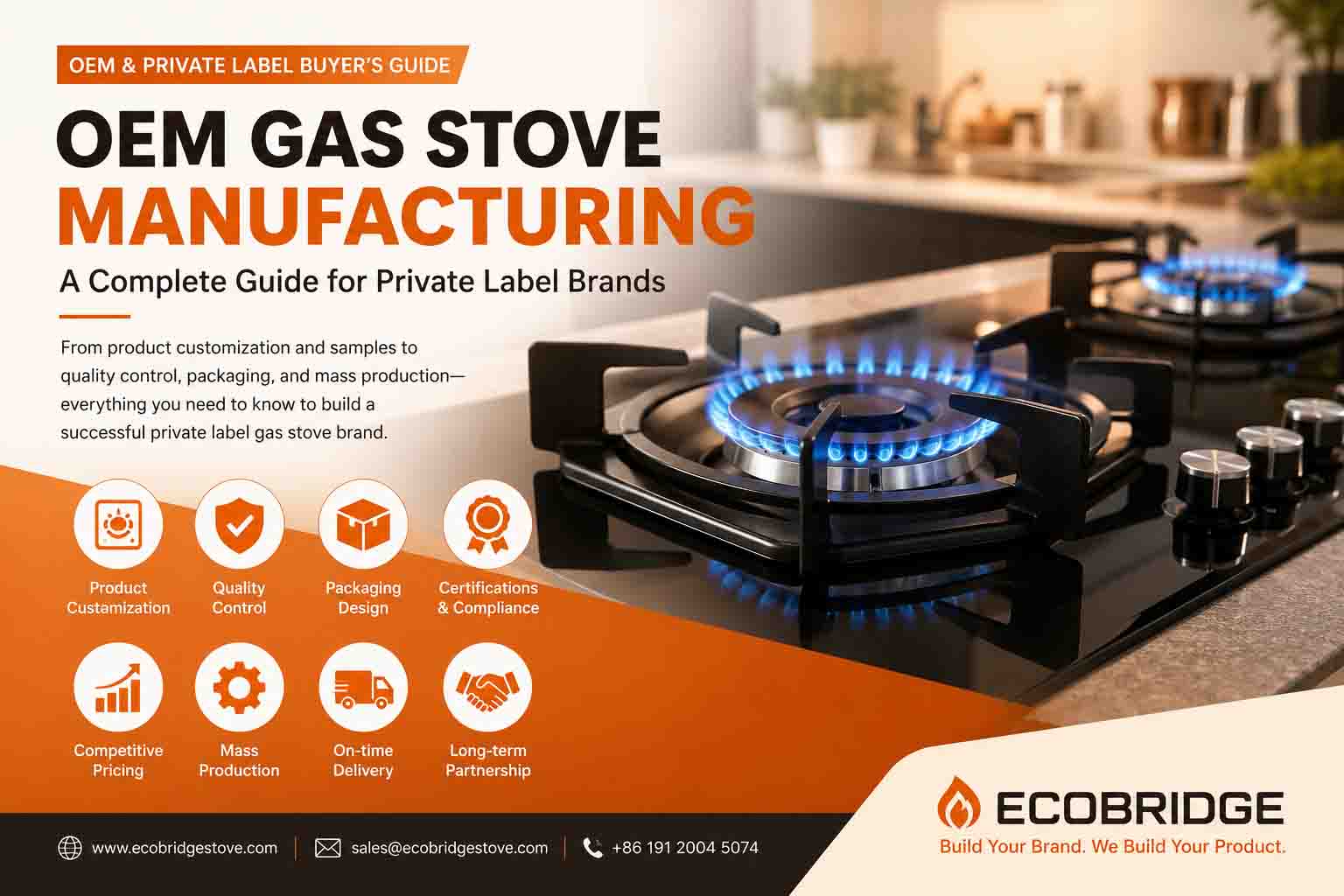
Launching a private-label gas stove brand involves much more than placing your logo on an existing appliance.
Burner configuration, gas type, panel material, ignition system, packaging, certification and quality control
can all influence whether the finished product fits your target market.
For importers, distributors, wholesalers and appliance brands, understanding the
OEM Gas Stove Manufacturing process before placing a bulk order can reduce sourcing risks,
shorten development time and improve communication with the factory.
A successful OEM gas stove project starts with the target market rather than the logo.
Before requesting a quotation, define the destination country, gas type, burner configuration,
target price, certification requirements and expected purchasing volume.
Once these points are clear, the manufacturer can recommend a suitable production platform
and determine which customizations are commercially realistic.
- Destination market
- LPG or natural gas
- Burner quantity
- Target price
- Expected order volume
- Required certification
- Private-label requirements
What Is OEM Gas Stove Manufacturing?
OEM stands for Original Equipment Manufacturing. In an OEM project, a manufacturer produces gas stoves
according to specifications agreed with an importer, distributor, retailer or private-label appliance brand.
The finished products are then sold under the buyer’s own brand.
OEM development can range from simple branding changes to deeper product customization. For example,
a buyer may select an existing model and customize only the logo, carton and instruction manual.
Another buyer may request different burners, knobs, pan supports, panel materials, ignition systems,
gas configurations or surface finishes.
Therefore, OEM Gas Stove Manufacturing should be treated as a complete sourcing and
product-development process rather than simply a logo-printing service.
OEM vs. ODM Gas Stove Manufacturing
| Buyer Consideration | OEM Gas Stove | ODM Gas Stove |
|---|---|---|
| Product Base | Usually starts from an existing production platform. | Can involve deeper product development. |
| Customization | Logo, colors, burners, knobs, panels and packaging. | Structure, dimensions, appearance, tooling and components. |
| Development Time | Usually shorter. | Usually longer. |
| Investment | Generally lower when an existing platform is used. | May require additional engineering and tooling. |
| Best For | Importers, distributors and growing private-label brands. | Established brands seeking stronger differentiation. |
If you are entering a new market, an existing gas stove platform with selected OEM customization is usually
a lower-risk starting point. Once sales become stable, deeper ODM development can be considered.
The Complete OEM Gas Stove Manufacturing Process
Market Definition
Confirm destination country, gas type, customer segment, retail positioning and compliance requirements.
Product Selection
Choose the gas stove, cooktop or gas range platform that best matches your market.
OEM Customization
Confirm burners, panels, knobs, ignition, colors, logos and packaging requirements.
Quotation
Review unit price, customization costs, MOQ, tooling requirements and commercial terms.
Sample Approval
Evaluate appearance, function, dimensions, branding and packaging before production.
Mass Production
Manufacture according to the final approved specification and artwork.
Quality Control
Inspect gas safety, ignition, flame condition, workmanship, branding and packaging.
Shipment
Pack and prepare the finished gas stoves for export according to the agreed shipping terms.
Step 1: Define Your Target Market
One of the most common sourcing mistakes is choosing a gas stove before fully understanding the destination market.
Gas appliances can require different configurations depending on local fuel supply, cooking habits,
customer expectations, retail price levels and regulatory requirements.
Before contacting an OEM gas stove manufacturer, prepare:
- Destination country or region
- Target customer group
- LPG or natural gas requirement
- Tabletop stove, built-in cooktop or gas range
- Required number of burners
- Preferred panel material
- Target wholesale or retail price
- Estimated first order quantity
- Expected annual purchasing volume
- Required testing or certification
Step 2: Choose the Right Gas Stove Platform
Private-label brands do not always need to develop an appliance completely from zero.
Starting with an existing manufacturing platform can reduce development time, tooling requirements
and purchasing risk while still allowing meaningful customization.
ENTRY LEVEL
Single & Two Burner Gas Stoves
Compact configurations can suit smaller kitchens, rental properties and price-sensitive distribution channels.
MAINSTREAM
Three Burner Gas Stoves
Three-burner models provide additional cooking flexibility without requiring the footprint of a larger appliance.
CORE CATEGORY
Four Burner Gas Stoves
Four-burner configurations provide broad positioning potential for residential and mainstream appliance markets.
UPGRADE
Five Burner Gas Stoves
Five-burner products can support higher product positioning and greater cooking capacity for larger households.
BUILT-IN
Gas Cooktops
Built-in cooktops place greater emphasis on dimensions, surface material, burner arrangement and control design.
FULL APPLIANCE
Gas Ranges
Gas ranges combine cooking zones with an oven and therefore require more detailed functional and compliance planning.
Step 3: Decide What Your Private Label Should Customize
The goal of OEM customization is not to change every component. Private-label brands should focus on features
that create clear market differentiation without unnecessarily increasing cost, MOQ or development time.
Visible Customization
- Private-label logo
- Panel graphics
- Product colors
- Knob design
- Glass printing
- Packaging artwork
- Labels and manuals
Functional Customization
- Burner configuration
- LPG or natural gas
- Pan supports
- Ignition system
- Gas connection
- Selected components
- Product dimensions
Stainless Steel or Tempered Glass
Surface material can significantly influence appearance and market positioning.
Stainless steel provides a familiar and practical appliance appearance, while tempered glass
can support a more modern and decorative retail presentation.
Burner Configuration
Burner number, size and layout should reflect local cooking habits. Different markets may prefer
compact burners, higher-output burners or mixed burner combinations.
Knobs and Pan Supports
Although relatively small components, knobs and pan supports have a strong effect on product appearance,
usability and perceived quality. They can provide useful differentiation for a private-label collection.
Prioritize customization that customers can see or value. Panel finish, burner layout, knobs,
pan supports and packaging often create more commercial value than unnecessary structural changes.
Step 4: Develop Private-Label Packaging
Packaging should be considered part of the finished product, particularly for appliance retailers,
distributors and e-commerce channels.
- Brand logo
- Product model number
- Product photography
- Main selling points
- Barcode information
- Country-specific labels
- Instruction manual
- Shipping marks
- Customized carton artwork
Before approving artwork, buyers should carefully check product images, model numbers, gas information,
barcodes, labels and spelling.
Step 5: Understand MOQ and OEM Gas Stove Pricing
MOQ is not determined only by factory production capacity. Customized cartons, printed glass,
special colors and customized components can each have separate minimum production requirements.
Do not ask only, “What is your MOQ?” Instead, confirm the MOQ for the exact customized configuration
you intend to purchase.
Typical OEM cost factors include:
- Number and type of burners
- Panel material
- Pan support material
- Ignition system
- Product dimensions
- Custom colors
- Private-label printing
- Packaging requirements
- Order quantity
- Certification or testing requirements
When comparing quotations from different suppliers, make sure the specifications are actually comparable.
A lower unit price may reflect different burners, materials, accessories or packaging standards.
Step 6: Request and Approve an OEM Sample
Sample approval is one of the most important stages of OEM Gas Stove Manufacturing.
It allows buyers to verify the actual product before committing to mass production.
Appearance & Structure
- Panel appearance
- Product dimensions
- Burner arrangement
- Pan support fit
- Knob alignment
- Logo position
- Surface finish
Function & Packaging
- Ignition performance
- Flame stability
- Gas connection
- Control operation
- Product labels
- Packaging condition
- Included accessories
Keep the approved sample, product specification sheet and final artwork together.
These become important references for mass production and future repeat orders.
Step 7: Confirm Certification Requirements Early
Gas appliance requirements vary between destination markets. Private-label brands should identify
applicable safety standards, gas specifications, labeling requirements and certification needs before
finalizing the product.
Do not assume that one certificate automatically covers every country or every customized version.
Changes to burners, gas systems, ignition components or product structures may affect compliance requirements.
Importers should confirm applicable requirements with the relevant certification organization,
local authority or qualified compliance specialist for the destination market.
Step 8: Establish a Gas Stove Quality Control Plan
For private-label brands, product quality directly affects brand reputation.
A reliable OEM program therefore needs clearly defined inspection requirements before mass production begins.
Production Quality
- Incoming component inspection
- Panel workmanship
- Product dimensions
- Burner assembly
- Knob alignment
- Pan support installation
Functional & Final QC
- Gas leakage inspection
- Ignition testing
- Flame stability
- Control function
- Logo and labels
- Packaging inspection
Existing Model or Fully Customized Gas Stove?
| Your Business Situation | Recommended Direction |
|---|---|
| Launching a new appliance brand | Start with an existing platform plus private-label customization. |
| Testing a new country | Keep development simple and choose a proven market-oriented configuration. |
| Established distributor | Consider deeper component and appearance customization. |
| Need stronger differentiation | Discuss ODM development or more extensive structural changes. |
| Building a complete product range | Develop coordinated two-, three-, four- and five-burner models. |
What Should You Send to an OEM Gas Stove Manufacturer?
A clear sourcing inquiry usually receives a much more useful quotation than simply asking a supplier
to “send your best price.”
- Your company and destination market
- Required gas stove type
- Number of burners
- Preferred panel material
- LPG or natural gas
- Expected order quantity
- Estimated annual volume
- Private-label requirements
- Packaging requirements
- Required certification
- Target price if available
- Expected purchase schedule
Why Work with a Specialized OEM Gas Stove Manufacturer?
A suitable manufacturing partner should do more than assemble an appliance.
Private-label development requires coordination between product selection, component sourcing,
branding, production, testing, packaging and export preparation.
A professional OEM supplier should support:
- OEM and ODM development
- Different burner configurations
- Private-label branding
- Product customization
- Packaging development
- Quality-control procedures
- Export manufacturing
- Repeat-order production
The objective is not simply to purchase one container. A strong OEM program should create a product platform
that supports future reorders and expansion into additional cooking appliance categories.
Frequently Asked Questions
Can I put my own brand on a gas stove?
Yes. Private-label projects can include customized logos, product labels, instruction manuals, cartons and other branding elements.
Can burners, knobs and pan supports be customized?
Depending on the production platform, different component options can be discussed. More extensive modifications may affect MOQ and development cost.
Can I choose stainless steel or tempered glass?
Yes, depending on the selected gas stove or cooktop platform and your target market positioning.
What is the MOQ for OEM gas stoves?
MOQ depends on the model and customization level. Custom cartons, special colors, printed glass and customized components can each have different minimum quantities.
Should I order a sample before bulk production?
Yes. Sample approval allows you to verify appearance, operation, branding, specifications and packaging before mass production.
Can I develop several burner configurations under one brand?
Yes. Depending on available production platforms, brands can build coordinated two-, three-, four- and five-burner product ranges.
ECOBRIDGE works with importers, distributors, wholesalers and private-label appliance brands
on OEM and ODM gas stove projects. Send us your target market, required burner configuration,
expected quantity and branding requirements to discuss a suitable manufacturing solution.
 English
  Spanish
  Portuguese
  French
  Dutch
Dutch  Bengali
  Russian
  Arabic