Blogs

Home / Archive by category "Blog"
All the news you need to know about ECOBRIDGE 
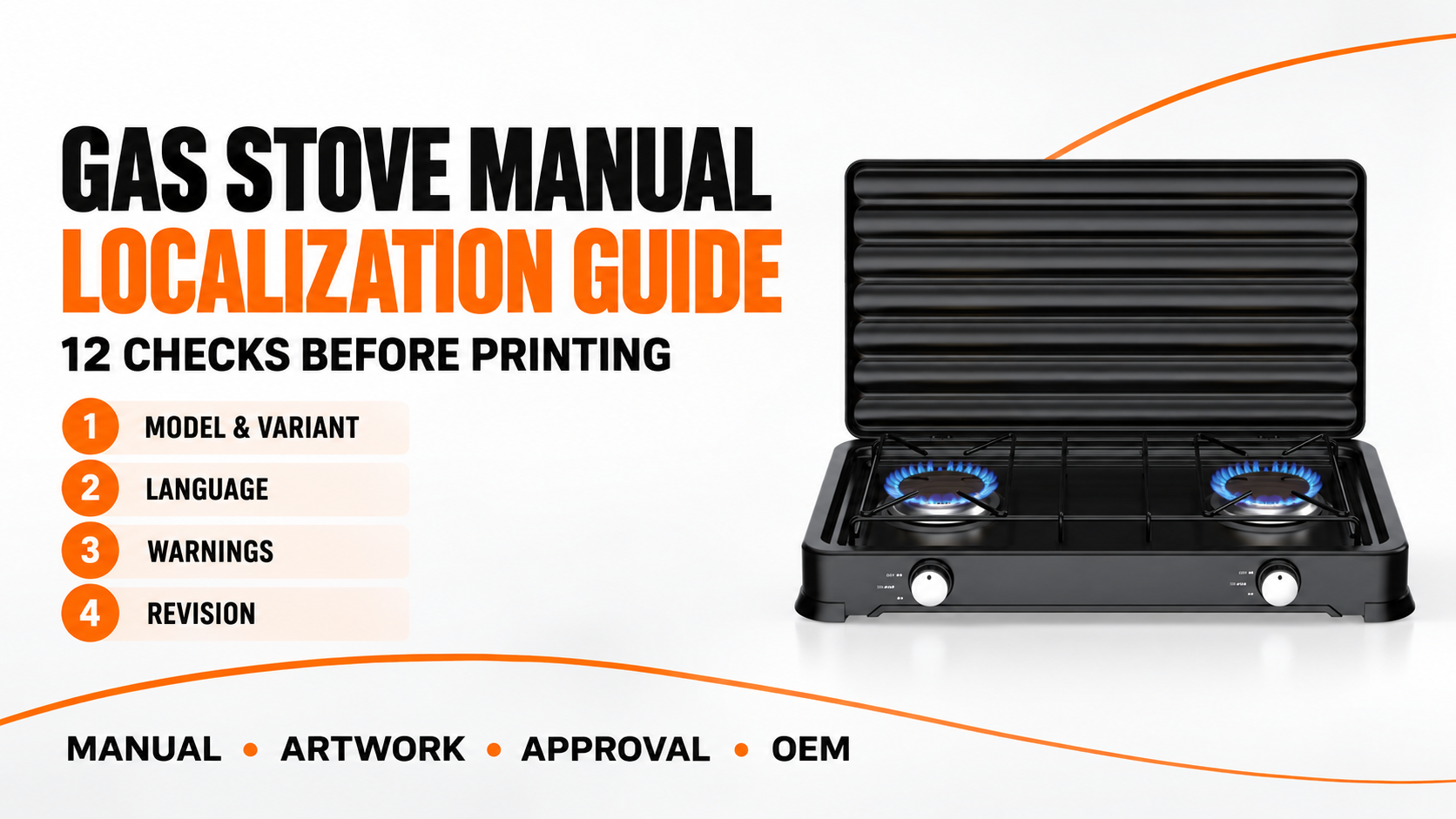
Model 6012L two-burner tabletop gas stove on a gas stove manual localization guide cover

Gas Stove Instruction Manual Localization: 12 Buyer Checks

An instruction manual can be inside every carton and still be wrong for the shipment. The usual failure is not missing paper. It is a mismatch between the manual, the approved product version, the destination language, the artwork revision, and the files released to the printer. For an importer or private-label buyer, the practical question is: what must be locked before a gas stove manual is printed and packed? The safest answer is to approve one controlled manual package for each sellable product and market combination. That package should identify the model and variant, state the target language, use verified product information, show the correct diagrams, record the revision, and connect the approved print file to the purchase order. This guide turns that principle into a buyer-side workflow. It does not prescribe legal wording for a particular country. Local requirements, warnings, installation instructions, importer details and conformity statements must be confirmed for the destination market and the exact product configuration. Quick Answers for Importers Buyer question Practical answer Evidence to retain Can one manual cover several models? Only when every covered model and variant is explicitly listed and the shared instructions remain accurate for each one. Model applicability matrix and approved master file Is translation alone enough? No. Localization also requires product, market, diagram, warning, contact and revision checks. Bilingual review file and approval record When should the manual be approved? Before mass printing and before the packing standard is released. Final PDF, approval date and controlled filename Who should verify technical content? The supplier confirms product-specific facts; the buyer confirms destination-market and brand requirements; qualified local review is used where required. Responsibility table with named approvers What creates the highest version risk? A late product, component, label or artwork change after the manual has been translated. Change notice and

Read More »
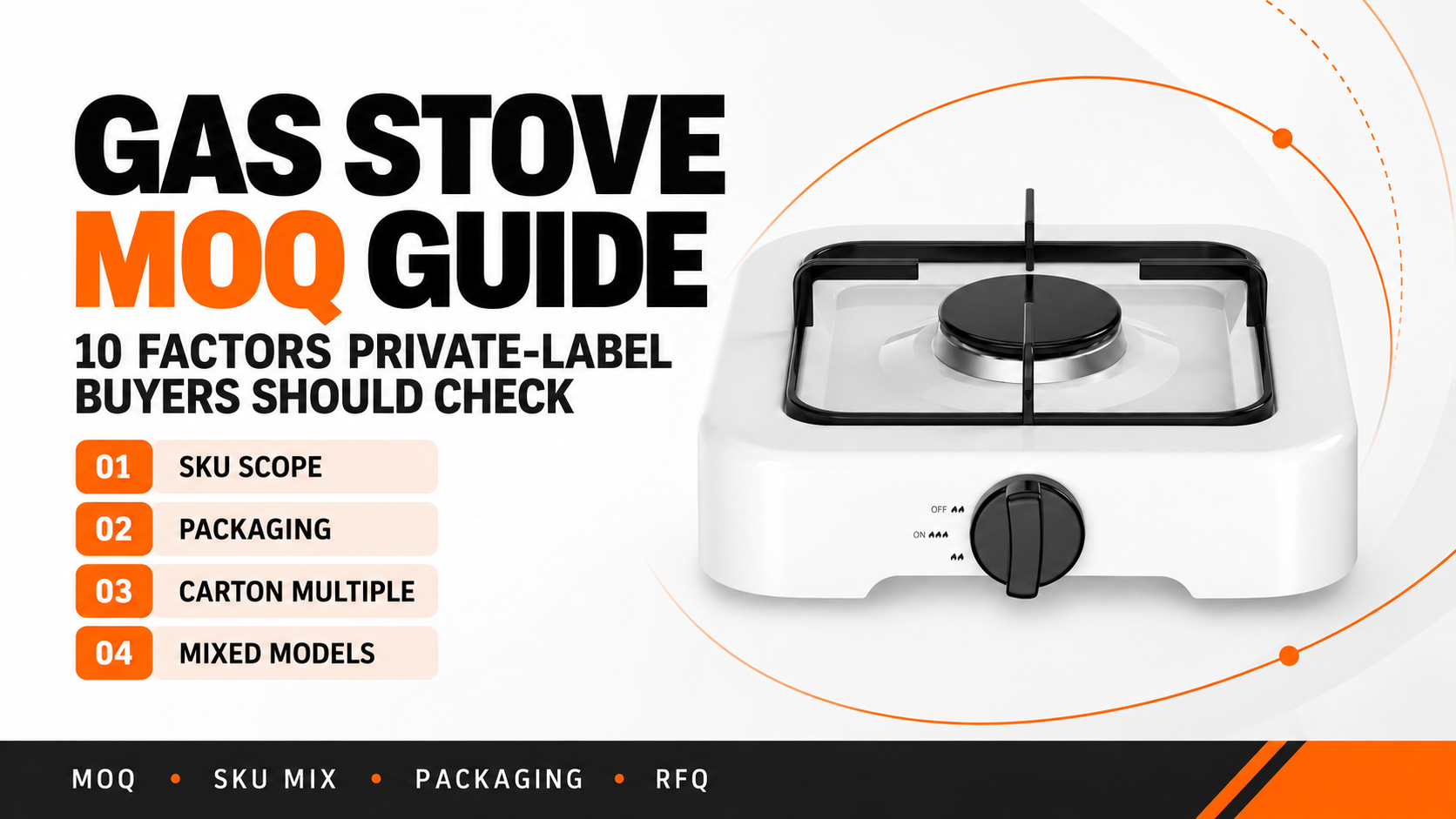
White single-burner tabletop gas stove in gas stove MOQ buyer guide

Gas Stove MOQ: 10 Factors Private-Label Buyers Should Check

When a private-label buyer asks, “What is your MOQ?”, the useful answer is rarely one number. A workable minimum order quantity must identify the exact stove version, packaging, printed materials, accessories, market configuration and SKU split. Without that scope, two suppliers can quote the same MOQ while committing to very different orders. This guide gives importers, distributors and brand purchasing teams a practical way to define, compare and negotiate a gas stove MOQ. It also shows how to separate a true production minimum from a carton multiple, packaging minimum or component minimum. The aim is to make the first quotation comparable and reduce changes after artwork, samples or production have started. Quick Answers for Gas Stove Buyers Buyer question Practical answer Is MOQ one factory-wide number? No. Ask for the MOQ of the exact SKU, market configuration and packaging version you plan to buy. Is units per master carton the MOQ? No. Carton quantity is a packing multiple. It may affect the final order quantity, but it does not prove the factory’s production minimum. What can raise MOQ? Custom components, special finishes, printed packaging, market-specific labels and manuals, accessory changes and splitting volume across many SKUs can all create separate minimums. Can several models be combined? Sometimes, but only if the supplier confirms how the total and per-SKU minimums work. Do not assume mixed models share the same components or production run. What should appear on the quotation? MOQ per SKU, carton multiple, allowed SKU mix, packaging version, customization scope, open items and the validity of the offer. What if the supplier cannot confirm every item? Record each item as pending confirmation and state who will close it before sample approval or purchase order release. 1. Define the Buying Unit Before Asking for MOQ The first task is to define

Read More »
Black two-burner Model 6002LC gas stove beside a quotation comparison checklist for importers

How to Compare Gas Stove Quotations: 12 Fields for Importers

A low unit price can become an expensive purchasing decision when two gas stove quotations describe different products. One supplier may include a lid, adapter, instruction manual and reinforced carton, while another may price only the basic appliance. A quotation can also use an incomplete model name, an unconfirmed gas configuration or packing figures taken from a similar product. For an importer, distributor or private-label buyer, the first task is to make every supplier quote the same requirement. Only then can price, packing, documentation and commercial terms be compared without hiding differences inside the quotation. This guide gives buyers a 12-field comparison method, a quotation-normalization worksheet, an open-point register and a copy-ready supplier email. A first-party ECOBRIDGE example later in the article shows why two products with the same listed carton size and carton quantity can still require separate quotations. Quick Answers for Gas Stove Importers Buyer question Quick answer What makes two gas stove quotations comparable? Both must cover the same product identity, destination, gas configuration, included parts, packaging basis, documents, quantity and commercial scope. Should the lowest unit price win? No. A lower figure may exclude parts, packing, artwork, documents or services included elsewhere. Compare the normalized scope and unresolved risks. Can model numbers be compared without suffixes? No. Record the complete supplier model and revision. A suffix may identify a different construction or option, and its meaning must be confirmed rather than guessed. Are catalog packing figures enough? They are useful reference data. The quotation should identify the final carton revision, units per carton, weight basis and whether loading quantities are estimates or approved order data. What should stop quotation approval? Hold approval when product identity, gas configuration, major inclusions, packaging basis, document scope or open cost assumptions are still unclear. The Buying Decision: Are the Quotations

Read More »
gas stove spare parts plan

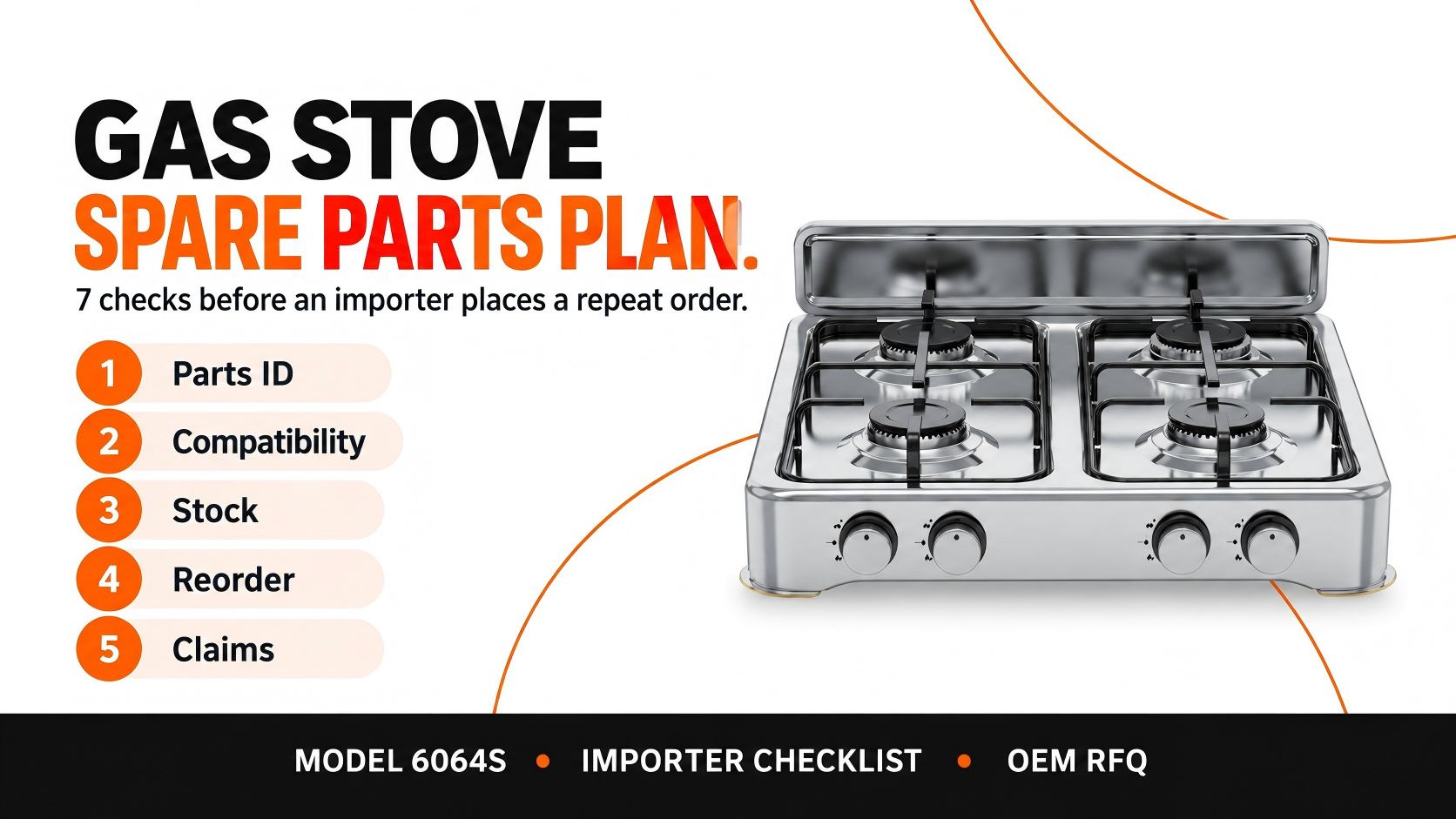
Gas Stove Spare Parts Plan: 7 Checks for Importers

A missing replacement part can turn a routine service request into a returned stove, a delayed distributor order or a customer who stops buying. Before placing a gas-stove purchase order, an importer needs to know which parts can be identified, which versions they fit, who can replace them, and how quickly they can be reordered. If those answers are missing, the spare-parts plan is still open—even if the supplier says that parts are available. This guide gives importers and private-label teams a practical approval method: seven checks, a parts-schedule template, a way to estimate opening stock from sales forecasts and service data, and a supplier email they can send before order release. Use it alongside the approved sample and specification for the exact product and destination market. Quick Answers for Gas Stove Importers Buyer question Quick answer When is a spare-parts plan ready? When every promised item has a controlled identity, approved compatibility boundary, order unit, stock assumption, replenishment route and service responsibility for the exact production version. Is a percentage of free spares enough? No. A percentage does not define the item mix, calculation base, coverage period, compatibility or reorder process. Can a photo prove that a part fits? No. Photographs help identify visible versions, while fit and technical suitability require appropriate drawings, measurements, sample checks or engineering evidence. Should every part be customer replaceable? No. Separate consumer-handling items from parts that require an authorized or qualified service route, especially gas-carrying or safety-related components. How should launch stock be calculated? Use the expected installed population, available service history, resolution path, replenishment time and revision risk. State assumptions and review them when field data arrives. The buyer is approving a service system, not only a box of parts. The schedule needs to work for purchasing, warehouse, distributor support and the

Read More »
Two-burner Model 6022G gas stove in a component change approval guide

Gas Stove Component Change Approval Guide for Importers

A supplier may describe a new burner, knob, support, carton or internal component as a minor substitution. For an importer, the size of the part is not the approval test. The decision depends on which product definition, market evidence, sample, label, artwork, logistics figure or inspection criterion becomes inaccurate after the change. Uncontrolled substitutions create a version problem. Purchasing may approve one configuration, the factory may build another, and the inspection company may continue checking an old reference. A change that appears acceptable in a photograph can still affect fit, gas configuration, documents, packing or after-sales support. This guide gives importers, distributors and private-label teams a practical approval route: classify the change, identify affected evidence, choose the required review, update controlled documents and record the first production lot. A real product-family comparison appears later only to show why shared burner count or appearance does not prove interchangeability. Quick answers for gas stove importers Buyer question Quick answer When does a gas stove change need approval? Whenever it can affect the ordered identity, technical configuration, visible construction, dimensions, packing, documents, inspection criteria, or destination-market evidence. Can the supplier decide that a change is minor? The supplier can describe the change, but the buyer should decide the approval route from the affected evidence and purchase requirements. Does the same burner count or similar appearance prove interchangeability? No. Products can share a sales description while differing in dimensions, components, packing, documents or production identity. Compare the exact approved references. Does every change require a new physical sample? No. The decision depends on the change. Some changes may need a document update; others need a revised sample, packing trial, technical review, or several of these actions. What should stop production release? Stop when the exact revised configuration cannot be linked to one controlled model

Read More »
Three-burner tabletop gas stove beside a golden sample approval checklist for importers

Gas Stove Golden Sample Approval Guide for Importers

Mass production becomes difficult to control when purchasing, the factory and the inspection company are comparing different references. A catalog image may show one finish, the approved sample may contain a revised knob, and the inspection brief may use an older packing list. The phrase “same as sample” does not solve this problem unless the sample can be identified and linked to current documents. For an importer, distributor or private-label brand, a gas stove golden sample should answer one purchasing question: what exact product must mass production match, and which requirements still need separate evidence? The useful record identifies the retained unit, visible configuration, document revisions, checks completed, exceptions and reapproval triggers. It does not turn one physical unit into proof of every technical, compliance or performance claim. This guide gives buyers a controlled approval method, a photo plan, a record template, an inspection handover and a list of mistakes to avoid before production release. Quick Answers for Gas Stove Importers Buyer question Quick answer What is a gas stove golden sample? A uniquely identified physical unit retained as an agreed comparison reference and linked to dated specifications, photographs and approval records. Is signing the carton enough? No. The unit needs a sample ID, a defined approval scope, document revisions, exceptions and named approvers. Does a golden sample prove market compliance? No. It can record visible and agreed configuration, while gas suitability, testing and destination requirements need their own documents and qualified review. Who should retain it? Agree which buyer, factory or inspection location keeps the controlled unit and how another team can access verified photos or duplicate samples. When is reapproval needed? When a proposed change makes the approved unit, photograph, specification, label, manual, packing or inspection criterion inaccurate. The approval decision is stronger when it says what the

Read More »
Four-burner gas stove with packaging artwork approval checklist for importers

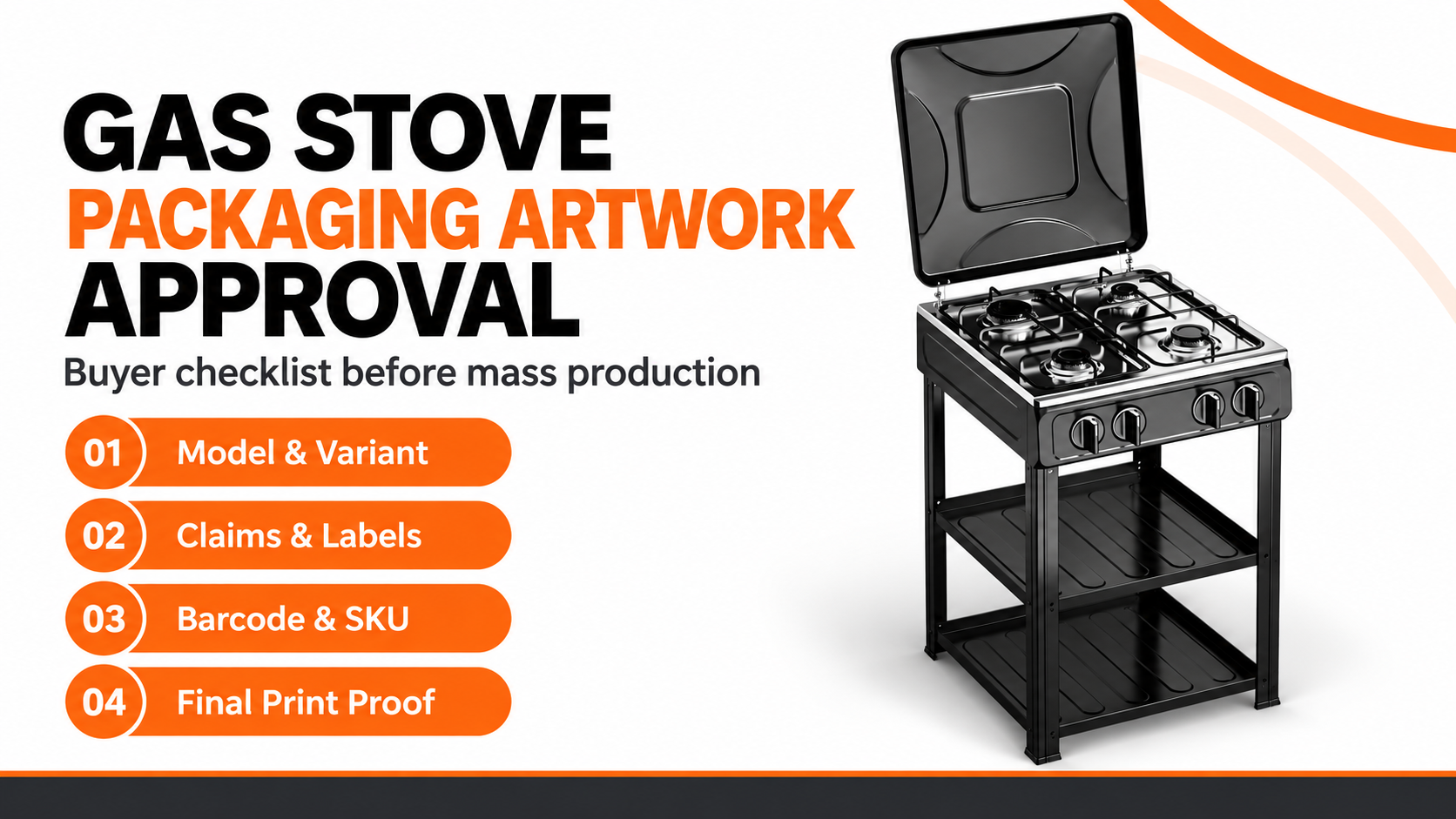
Gas Stove Packaging Artwork Approval: Buyer Checklist

A gas stove can be built to the approved sample and still reach the market in the wrong box. A photograph may show another burner layout, a barcode may identify another SKU, or the language file may belong to a different destination. Once thousands of cartons are printed, a small artwork mismatch becomes a relabeling, repacking or shipment problem. For an importer, distributor or private-label brand, packaging approval should answer one release question: does this exact print file describe the exact product, contents and destination of the purchase order? Design quality matters, but the release also depends on controlled product evidence, verified copy, a current dieline, an identifiable proof and a record of who approved each part. This guide provides a quick-answer table, a four-file control set, a functional review workflow, a first-print check, common mistakes and a copy-ready approval record. Quick Answers for Gas Stove Importers Buyer question Quick answer When is retail-box artwork ready to print? When the final file matches the approved product variant, contents, destination, language set, barcode data and current dieline, with all required reviews closed. Is approving a PDF enough? Only when the approval identifies the exact filename and revision and the buyer has decided whether a physical or production proof is also required. Who should check gas-related and safety wording? Assign the relevant product and destination-market review to qualified people; a graphic designer should not be treated as the technical approver. Can one box be reused for several variants? Only after the buyer confirms that the product image, identifiers, claims, labels and market requirements remain correct for every intended variant. What should stop printing? Any unresolved mismatch in product identity, barcode, gas-related wording, included contents, required language, regulatory copy or dieline revision. The strongest release record separates what marketing approves from what product,

Read More »
Four-burner gas stove beside a specification sheet checklist for importers

Gas Stove Specification Sheet: 12 Checks for Importers

A quotation can look complete while the supplier and buyer are pricing different products. One file may describe a three-burner body, another may show a different support or lid, and the packing figures may come from an older carton. If purchasing compares only model names and unit prices, these differences can surface after the sample, artwork or shipping plan has already been approved. For an importer, distributor or private-label buyer, a gas stove specification sheet should answer one question: can every team identify the exact configuration covered by the quotation, sample, documents and shipment? A useful sheet separates confirmed facts, selectable options and open fields, names the source for critical data, and carries a revision that can be linked to the purchase order. This guide provides a quick-answer table, twelve field checks, an evidence hierarchy, a supplier comparison method, common mismatch controls and a copy-ready request. Quick Answers for Gas Stove Importers Buyer question Quick answer Is a catalog page a final order specification? Usually no. It begins product selection, while the final order needs the exact variant, destination, gas configuration, packing and revision status. Which fields should stop quotation approval? Hold when product identity, destination, fuel or pressure basis, burner layout, critical options, packing basis or applicable document scope is unclear. How should unconfirmed data be shown? Mark it “to be verified,” assign an owner and evidence source, and close it before the milestone that depends on it. Can data from a similar model fill a blank? No. Similar appearance or family naming does not prove identical construction, gas configuration, dimensions, packing or document coverage. What makes two supplier quotations comparable? Both replies must describe the same requirement and state their exact configuration, inclusions, packing basis, assumptions and open points. A usable gas stove specification identifies the model and

Read More »
LPG vs natural gas stove

LPG vs Natural Gas Stove: Importer Guide for Gas Appliance Buyers

IMPORTER GUIDE LPG vs Natural Gas Stove: Importer Guide for Gas Appliance Buyers A practical guide to fuel configuration, pressure, certification, OEM manufacturing and quality control for international gas appliance buyers. Quick Answer: LPG stoves are generally configured for cylinder-supplied gas, while natural gas stoves are designed for pipeline-supplied gas. The two versions may require different injectors, valves, pressure settings, connections and certification documents. Introduction When comparing an LPG vs natural gas stove, importers need to evaluate more than fuel availability or consumer preference. LPG and natural gas appliances use different gas pressures, injector sizes, burner settings, valves, connection systems and documentation requirements. A stove designed for one fuel type cannot automatically be treated as suitable for the other. This issue is especially important for overseas importers, distributors, wholesalers, private-label brands and OEM purchasing managers. If the fuel specification is incorrect, the appliance may experience unstable flames, poor combustion, ignition problems, failed testing or customer complaints after shipment. These issues may also lead to relabeling, component replacement, delayed customs clearance or costly returns. The correct fuel configuration should be confirmed before the quotation, sample, packaging artwork and production schedule are approved. This guide explains the technical and commercial differences between LPG and natural gas stoves, how fuel type affects manufacturing, and what buyers should verify before placing a bulk order. LPG vs Natural Gas Stove: The Technical Difference An LPG stove is designed for liquefied petroleum gas, which is commonly supplied from a cylinder or tank. A natural gas stove is designed for pipeline-supplied gas. Although both appliances use burners to produce heat, their internal gas systems are not necessarily the same. Factor LPG Stove Natural Gas Stove Typical gas supply Cylinder or tank Pipeline Appliance pressure Usually higher Usually lower Injector opening Usually smaller Usually larger Typical applications Homes,

Read More »