Blog

Home / Blog

Practical sourcing knowledge for gas stove importers, distributors and private-label buyers. Explore product selection, OEM branding, quality control, packaging and destination-market planning, with clear questions to confirm before quotation, sample approval and repeat orders.

gas stove sourcing guide

Gas Stove Sourcing Guide: 5 Questions for Importers

Gas Stove Sourcing Guide: 5 Questions Importers Should Ask Before Ordering Sourcing gas stoves for wholesale is not simply about finding a model, comparing factory prices, and placing an order. For importers, distributors, appliance wholesalers, retailers, and private-label brands, the right gas stove depends on several factors: the destination market, gas type, burner configuration, product positioning, local requirements, customization needs, packaging, production lead time, and container efficiency. A gas stove that works well in one market may require a different configuration for another country. Even two products that look almost identical can differ in burner systems, gas pressure requirements, valves, ignition components, materials, packaging, testing requirements, and production cost. This gas stove sourcing guide answers five important questions wholesale buyers should discuss with a manufacturer before approving samples or placing a bulk order. Quick Answers for Gas Stove Importers Question Quick Answer How do I choose the right gas stove? Start with the destination country, target customer, gas type, burner quantity, materials, features, and retail price positioning. Should I choose LPG or natural gas? Confirm the gas supply and operating requirements of the destination market before approving production. What certifications and tests are required? Requirements vary by country and product configuration. Confirm applicable regulations, testing, labeling, and documentation before mass production. Can gas stoves be customized for my brand? Yes. OEM projects can include logos, packaging, colors, panels, knobs, labels, manuals, burner configurations, and other product details. What should I confirm before placing a bulk order? Confirm MOQ, samples, final specifications, lead time, packaging, inspection requirements, carton dimensions, and container-loading quantity. These five questions provide a more reliable way to compare gas stove manufacturers than looking at unit price alone. 1. How Do I Choose the Right Gas Stove Specification for My Market? The right gas stove should be selected

Read More »
Gas stove wholesale price guide illustrated with the ECOBRIDGE 6504S stainless steel cooktop, five burners, enameled pan supports and five silver knobs

Gas Stove Wholesale Price: What Changes the Quote?

A gas stove wholesale price is the supplier’s selling offer for a particular configuration, quantity and delivery scope. It does not reveal the factory’s internal manufacturing cost. To understand a higher or lower quote, identify the exact change, separate recurring charges from one-time expenses, and calculate the effect on the order you will actually buy. For an importer or private-label buyer, “make it cheaper” is an incomplete instruction. A useful negotiation asks what can change while the required cooking layout, destination configuration, packing protection and other essential requirements remain intact. Buyer decision rule: approve a price revision only when you can explain what changed in the product or commercial scope, what the change costs for the current quantity, and which expenses remain outside the quoted amount. In this guide Price versus cost A real configuration comparison Types of charges Worked purchase calculation Request a revised offer Start with three different numbers Manufacturing cost concerns the supplier’s inputs and production expenses. Quoted selling price is what the supplier offers to charge for the stated goods and terms. Your acquisition budget includes that purchase and the additional expenses your business must arrange to receive and sell it. These figures answer different questions. A supplier’s price increase does not, by itself, show how much its material cost increased. A reduction in manufacturing expense does not establish an equal reduction in selling price. Without an actual cost breakdown and an agreed pricing arrangement, buyers should avoid estimating a factory’s margin from a photograph or a competing quotation. For the purchasing discussion, ask for the current offer, its inclusions and its separately priced alternatives. The US International Trade Administration’s pro forma invoice guidance describes a quotation in invoice form and identifies fields including unit and extended prices, product weights and dimensions, delivery terms, discounts and

Read More »
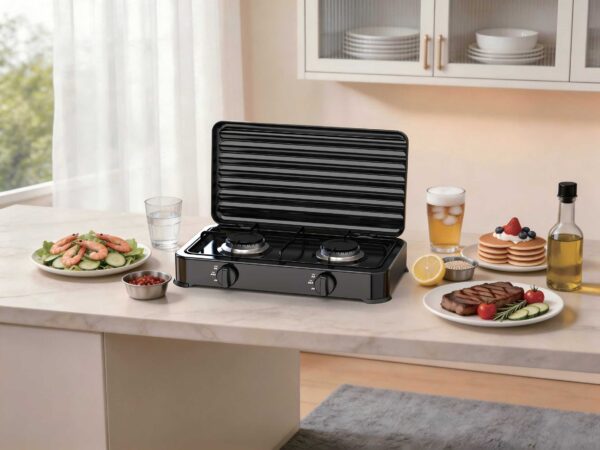
ECOBRIDGE Model 6003 black three-burner tabletop gas stove with a raised ribbed lid and three white-faced controls.

OEM Gas Stove Manufacturing: A Complete Guide for Private Label Brands

Before releasing an OEM gas stove order to volume production, review one unit built from the intended production materials and instructions. Match the unit, its identification and its pack to the version you approved. Then record what the factory can proceed with and which findings still require a decision. Agree on this checkpoint before placing the order. A development sample helps you choose the product and finish. The first production unit shows how the released instructions were applied on that build. A later shipment review covers the identified lot. Each decision needs evidence from the relevant stage. Give the factory a buildable order Start with the model, destination, gas configuration and any change the private label needs. Keep the commercial offer tied to that version. If the buyer and factory use OEM and ODM differently, write down who owns the drawings, who can approve a change and which existing or new components are in scope. The ECOBRIDGE private-label buying guide covers the broader sourcing choices. At sample approval, record the reference unit, approved dimensions and measurement convention, parts and finishes, and the revisions of the rating plate, instructions and pack. Give the production lead a single release packet. If the order specification conflicts with an old drawing, resolve the difference before the lead issues the work instructions. Why two three-burner models need different first-run checks The ECOBRIDGE Model 6003 product page lists a 577 × 278 × 53 mm product and a 595 × 70 × 335 mm individual box. The ECOBRIDGE April 2026 catalog, printed page 06, gives those same 6003 entries. It lists Model 6003H at 577 × 278 × 66 mm and illustrates a different lid and knob presentation. Both models have three burners and the same listed length and width. The listed heights differ by 13

Read More »
CKD vs CBU gas stoves

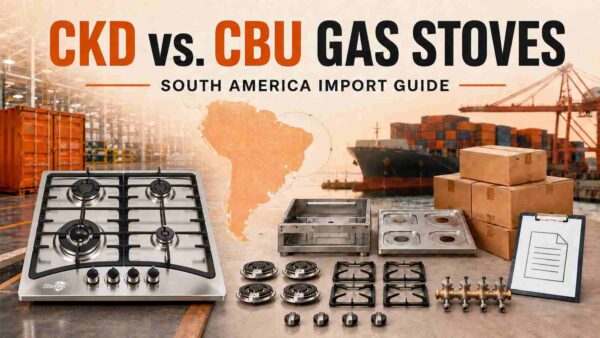
CKD vs. CBU Gas Stoves: How to Reduce Import Tariff in South America

South America Import Strategy · Updated August 2026 The lowest factory price does not always produce the lowest landed cost. Choosing CBU, SKD, or CKD depends on classification, origin, local assembly, taxes, freight, and compliance. For gas stove importers, CKD vs CBU gas stoves may look like a simple tariff decision. In practice, South America is not one customs market, and CKD does not automatically receive a lower duty rate. At EcoBridge, we manufacture OEM and ODM gas stoves for international brands and distributors. This guide explains how to compare the formats and build a compliant import plan. Always confirm the final code, origin rule, and taxes with the destination customs authority or a licensed broker. The central customs rule A shipment does not become “parts” only because the stove is unassembled. Under the World Customs Organization’s General Interpretative Rule 2(a), a complete article presented unassembled or disassembled can be classified in the same heading as the assembled article. CKD vs CBU Gas Stoves: What Do the Terms Mean? CBU, SKD, and CKD describe how products leave the factory. They are logistics terms—not tariff codes. Customs classification depends on the goods as presented, Harmonized System rules, national schedules, and supporting documents. Format How It Is Supplied Local Work Required Main Customs Question Typical Fit CBU Complete Built-Up stove, assembled and factory tested Inspection, labeling, and distribution Finished-product code, origin, and applicable preference Fast market entry, lower volume, limited local production SKD Semi Knocked-Down modules, such as body, top panel, and burner system Module assembly, connection, leak and function testing Does the shipment already have the essential character of a stove? A staged move toward local assembly CKD Complete Knocked-Down components for local assembly Assembly, gas and electrical tests, final QC, and packing Are these genuine separately classified parts, or an

Read More »
import gas stoves from China

How to Import Gas Stoves from China: A Complete Guide for Importers

China offers importers a broad choice of gas stoves, flexible OEM options, and scalable production. However, a successful order depends on much more than finding the lowest unit price. To import gas stoves from China successfully, buyers must define market-specific requirements, verify compliance, control production, and plan customs clearance before placing a deposit. This guide covers the process for importers and private-label brands. Import Roadmap 01 Define specifications 02 Confirm compliance 03 Verify the factory 04 Approve a sample 05 Lock the contract 06 Inspect production 07 Ship and clear customs 08 Manage after-sales 1. Define Specifications Before You Import Gas Stoves from China Start with the destination market, not the supplier catalog. Gas types, supply pressures, installation methods, electrical systems, and consumer preferences vary by country. A model that works in one market may be unsafe or non-compliant in another. Your request for quotation should specify: Freestanding range, built-in cooktop, tabletop stove, or portable model LPG, natural gas, or approved conversion configuration Local gas category, inlet pressure, injector size, and required heat input Number and type of burners, ignition system, and flame-failure protection Panel material, pan supports, knobs, dimensions, voltage, plug, and power cord Branding, manuals, labels, retail packaging, carton strength, and spare parts Practical rule: Never ask only for “a four-burner gas stove.” A complete specification sheet prevents incorrect quotations, expensive redesigns, and certification delays. 2. Confirm Safety and Market Compliance Before Ordering Importers remain responsible for placing compliant products on their market. Therefore, confirm the applicable laws, standards, conformity assessment, labels, documentation, and local-language instructions before sample approval. Market Key Starting Point Importer Action European Union Regulation (EU) 2016/426 on appliances burning gaseous fuels; third-party conformity assessment and CE marking Verify the notified-body certificates, model identification, EU Declaration of Conformity, technical documentation, traceability labels, and required language

Read More »
Hot plate buyer guide featuring the ECOBRIDGE SHP-5829B with two round cooking plates, two control knobs and red indicator lights.

What Is a Hot Plate? Electric Cooking Basics for Buyers

A hot plate is a compact cooking appliance that provides one or more heating zones for pots and pans. This guide concerns electric cooking hot plates, rather than laboratory heating equipment. For a buyer, the first decision is the heating technology: does an electric element transfer heat to the pan, or does an induction system heat compatible cookware electromagnetically? Choose by heating type, rated electrical supply, cookware and permitted use setting, then compare the exact models. The word “portable,” a black cooking surface or a familiar-looking plug does not establish that an appliance suits a particular room, electrical supply or cooking task. Below, a real ECOBRIDGE two-zone product entry shows which information helps selection and which details still need confirmation. Importers, distributors and private-label buyers can reuse the short selection brief at the end. How does an electric hot plate heat a pan? Electric resistance and induction are different heating methods. New Zealand’s Energy Efficiency and Conservation Authority explains that resistance cooktops transfer heat from a burner or element to cookware. Induction instead uses an electromagnetic field to heat the pot or pan. A smooth cooking surface can appear on either type, so appearance alone is an unreliable technology label. The useful distinction is the path the heat takes, rather than whether a product looks modern. On a small screen, scroll the comparison sideways. Heating method What the technology does What the buyer should confirm Electric resistance An electrically heated element transfers heat to the cookware. Heating-surface construction, permitted pan sizes and materials, control method and rated input Induction An electromagnetic field heats compatible cookware. Compatible cookware, usable pan-base sizes and the specific model’s operating instructions The comparison describes the two technologies, not a performance test of an ECOBRIDGE model. Do not convert a technology description into a claim that

Read More »
Gas Stove Manufacturer

Gas Stove Manufacturer Inspection Checklist: What Smart Appliance Buyers Look for before Ordering

A gas stove manufacturer inspection should establish whether the proposed factory can control your product and order, using current records from the actual production site. A certificate, showroom sample or impressive production figure cannot answer that question alone. Before approving a supplier, connect the factory identity, production scope, product requirements and inspection evidence. This checklist helps importers, distributors and private-label buyers plan a supplier audit. Use it to decide what to inspect, what records to request and which gaps need resolution before an order is released. It does not set universal gas-test limits, certify a supplier or replace the product assessment required for a destination market. Start with the factory and the work it will perform Put the contracting company, manufacturing-site address and proposed product range on the audit brief. Ask which operations take place at that site and which are purchased or subcontracted. A sales office, assembly plant and component supplier may contribute to the same order, but an audit of one does not describe all three. Then identify the models, configurations and order mix you want the auditor to examine. A demonstration on a different product can illustrate a process; it should not be recorded as evidence for your proposed production version without checking its relevance. Request permission to review representative records, observe relevant operations and discuss unresolved findings with the people responsible. Agree the scope with your auditor before the visit. Separate supplier qualification from the later pre-shipment inspection brief: the former assesses the proposed manufacturing arrangements, while the latter defines checks on an identified shipment. Passing one does not automatically close the other. Read management-system and social-audit evidence for their actual purpose ISO explains ISO 9001 as a quality-management-system standard; certification is carried out by independent certification bodies. When a supplier presents a certificate, check the

Read More »
Gas stove grate cleaning guide with ECOBRIDGE Model 6003, three burners, white knobs and raised black lid

How to Clean Gas Stove Grates: Check the Finish First

To clean gas stove grates, first check the care instructions for the exact model and grate finish. Where hand washing is permitted, let the appliance cool, remove the grates as instructed, wash with warm soapy water, rinse, dry completely and put them back in their correct positions. Samsung describes this approach for its grates; GE also describes washing, rinsing and drying for the grate types covered by its guidance. Neither page establishes a cleaning method for every gas stove. Samsung care guidance; GE grate guidance. The decision rule is simple: match the method to the part and the model before increasing the cleaning strength. A grate, a burner cap, a burner head and a griddle are different components. Permission to clean one of them in a particular way does not automatically cover the others. This guide covers removable pan supports, often called grates. It also gives importers and private-label buyers a care-instruction approval card. It does not provide instructions for dismantling gas connections or adjusting burners. Identify what you are about to clean Find the model reference and its current user manual. Locate the section for grates or pan supports, rather than a general paragraph about the stove surface. Record any separate instructions for caps, griddles, rubber feet or other attached parts. Do not identify a coating from a black photograph alone. If the manual does not establish the grate material, finish or cleaning method, ask the manufacturer to identify the supplied component. A useful question is: “Which care instructions cover the pan-support part fitted to this model revision?” The distinction matters in real product information. The ECOBRIDGE Model 6013 page lists “Pan support/grill” as “3.5*7.5” and separately describes a stamped aluminum base with an enamel fire cover. The enamel description belongs to that burner assembly entry; it does not

Read More »