South America Import Strategy · Updated August 2026
The lowest factory price does not always produce the lowest landed cost. Choosing CBU, SKD, or CKD depends on classification, origin, local assembly, taxes, freight, and compliance.
For gas stove importers, CKD vs CBU gas stoves may look like a simple tariff decision. In practice, South America is not one customs market, and CKD does not automatically receive a lower duty rate.
At EcoBridge, we manufacture OEM and ODM gas stoves for international brands and distributors. This guide explains how to compare the formats and build a compliant import plan. Always confirm the final code, origin rule, and taxes with the destination customs authority or a licensed broker.
The central customs rule
A shipment does not become “parts” only because the stove is unassembled. Under the World Customs Organization’s General Interpretative Rule 2(a), a complete article presented unassembled or disassembled can be classified in the same heading as the assembled article.
CKD vs CBU Gas Stoves: What Do the Terms Mean?
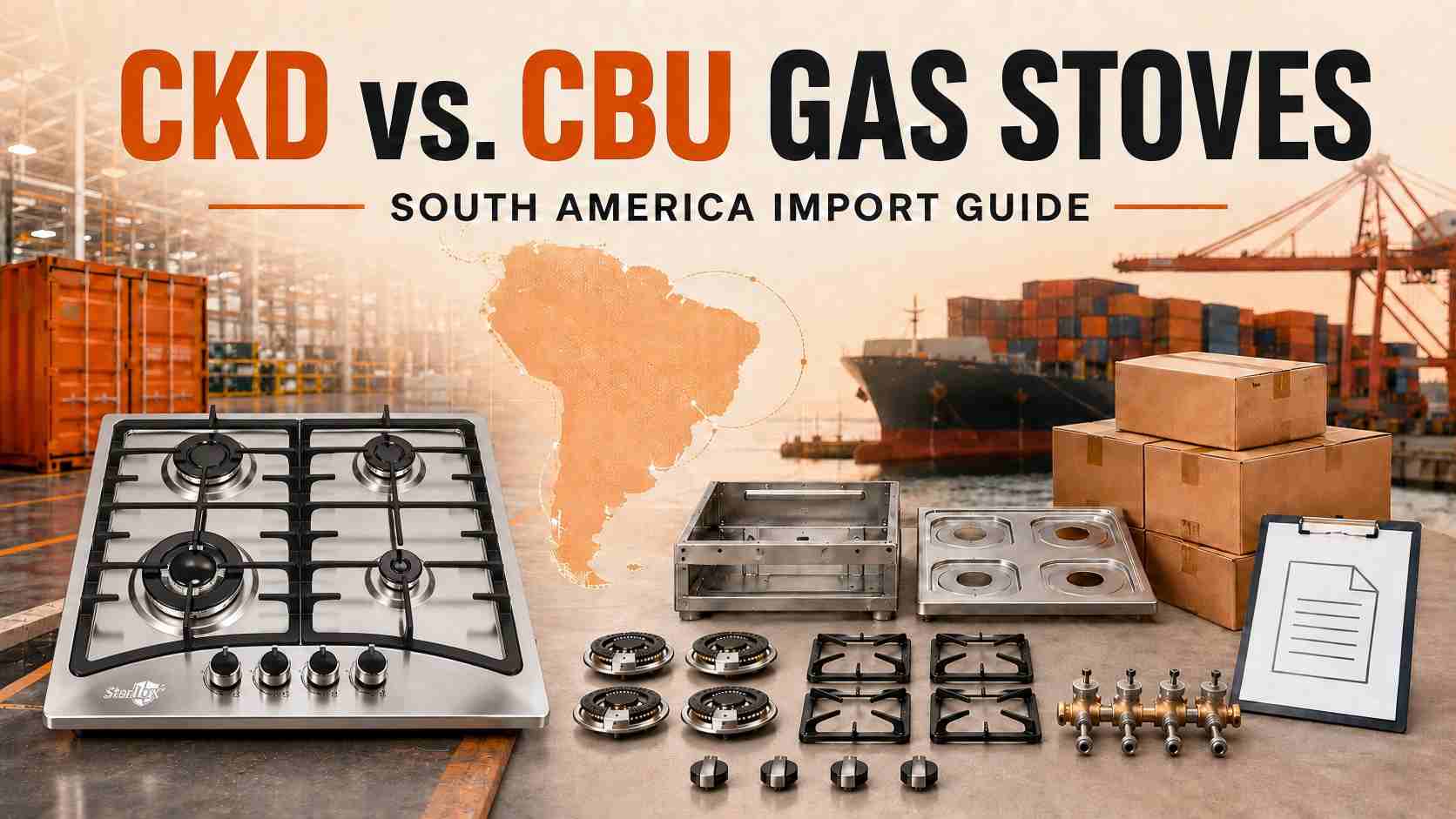
CBU, SKD, and CKD describe how products leave the factory. They are logistics terms—not tariff codes. Customs classification depends on the goods as presented, Harmonized System rules, national schedules, and supporting documents.
| Format | How It Is Supplied | Local Work Required | Main Customs Question | Typical Fit |
|---|---|---|---|---|
| CBU | Complete Built-Up stove, assembled and factory tested | Inspection, labeling, and distribution | Finished-product code, origin, and applicable preference | Fast market entry, lower volume, limited local production |
| SKD | Semi Knocked-Down modules, such as body, top panel, and burner system | Module assembly, connection, leak and function testing | Does the shipment already have the essential character of a stove? | A staged move toward local assembly |
| CKD | Complete Knocked-Down components for local assembly | Assembly, gas and electrical tests, final QC, and packing | Are these genuine separately classified parts, or an unassembled complete stove? | Stable volume and a capable local assembly partner |
Why CKD Gas Stoves Do Not Automatically Pay a “Parts Tariff”
Domestic gas cooking appliances made mainly of iron or steel are commonly reviewed under HS 7321.11. Qualifying parts may use 7321.90, while some components have other headings according to material and function. National codes extend beyond six digits, so the destination country controls the final answer.
If a shipment contains the components needed to build a complete stove, customs may decide that the collection already has the essential character of the finished appliance. It may remain classified as a complete stove under Rule 2(a), even when assembly occurs after arrival.
Compliance warning
Do not assume that splitting a kit across invoices or containers creates a lower tariff. Authorities may examine the full transaction, BOM, instructions, and commercial intent. Obtain a written advance ruling before relying on a parts code.
South America Is Not One Tariff Market
The same model can produce a different landed cost in Brazil, Chile, Peru, or Ecuador. Compare the relevant customs and trade-agreement route first.
| Market Route | Potential Opportunity | Critical Verification |
|---|---|---|
| Chile, Peru, and Ecuador | Each has a China trade agreement. A qualifying CBU or component line may receive a preference, making CBU more competitive. | Current national tariff line, phase-out schedule, product-specific origin rule, direct consignment conditions, and valid proof of origin |
| Brazil, Argentina, Paraguay, and Uruguay | MERCOSUR uses the NCM and a common external tariff framework. Regional preference requires the finished product to meet its origin rule. | Current NCM code and national exceptions, specific origin requirement, non-originating material limit, local processing, and origin documentation |
| Other South American markets | A parts rate, free zone, temporary admission, or drawback may improve the project. | Eligibility, domestic-sale restrictions, re-export obligations, guarantee requirements, tax treatment, and reporting deadlines |
Important: local assembly does not automatically convert Chinese components into MERCOSUR-origin stoves. Each tariff line has a specific origin requirement when imported materials are used, and the producer must keep supporting evidence.
7 Compliant Ways to Reduce Gas Stove Import Cost
1. Check preferential CBU duty before designing a CKD project
In Chile, Peru, and Ecuador, check the China trade agreement first. If the finished-stove line receives a strong preference, CKD may add labor, testing, and working-capital costs without enough duty savings.
2. Obtain an advance classification ruling
Provide the BOM, exploded drawing, photographs, assembly flow, packing plan, quantities, and shipment structure. A ruling can clarify treatment before you invest in tooling or an assembly line.
3. Build genuine local manufacturing value
A credible CKD plan uses real local operations—not only a few screws. Evaluate local panels, cabinets, packaging, wiring, fasteners, final assembly, calibration, leak testing, and inspection according to local capability and the applicable origin rule.
4. Use special customs regimes for the correct business model
Free zones, temporary admission, inward processing, and drawback can suspend, defer, or refund duties for re-export projects. Domestic release can trigger duties and taxes, so confirm controls and deadlines.
5. Optimize the BOM and container—not the declaration
Localize economical components while keeping critical gas-control parts in a qualified supply chain. Better carton dimensions and container utilization will not lower the tariff rate, but they can reduce freight per unit.
6. Keep customs value accurate
Customs valuation generally starts with the price paid or payable, with required adjustments. Tooling assists, packing, commissions, royalties, and transport may affect value. Undervaluation creates penalties and clearance risk.
7. Keep every document consistent
The invoice, packing list, BOM, order, labels, drawings, certificates, and declaration must describe the same structure. Identify genuine spares and excess components separately because they may require separate classification.
Calculate Total Landed Cost Before Choosing CKD vs CBU
Landed cost per sellable unit = product + freight and insurance + duty + non-recoverable taxes + port and broker fees + inland transport + assembly + QC and scrap + packing + tooling + compliance + financing.
Run all scenarios with the same volume, exchange rate, defect assumption, and tax treatment. Import VAT may be creditable, yet still affects cash flow. Low-volume CKD projects also underestimate training, fixtures, rework, and supervision.
CBU often wins on speed and simplicity. CKD becomes attractive when demand is stable, the tariff spread is confirmed, assembly is efficient, and the importer has a long-term regional strategy.
What a Bankable CKD Gas Stove Project Needs
Prepare this project brief before requesting a CKD quotation:
- Destination country, port, proposed tariff code, and broker’s written classification view
- Target model, burner configuration, gas type and pressure, ignition system, voltage, and plug
- Forecast by SKU, order frequency, and launch schedule
- Local processes available: stamping, coating, assembly, electrical work, gas testing, packing, and warehousing
- Local-content plan and the product-specific origin rule, if regional preference is a goal
- Required safety approvals, labels, language, manuals, and market-specific packaging
- Desired comparison among CBU, SKD, and one or more CKD levels
How EcoBridge Supports South American Importers
EcoBridge has more than 17 years of experience, a 20,000 m² factory, OEM/ODM capability, and annual capacity of up to 1.5 million units. Our range covers tabletop stoves, built-in cooktops, ranges, and ovens for finished-product or phased local-assembly projects.
Depending on the model, a CKD/SKD documentation package can include a structured BOM, exploded views, component identification, packing details, assembly guidance, and QC checkpoints. The importer and customs adviser remain responsible for classification and origin claims.
Explore our gas stove range or learn more about our factory.
Frequently Asked Questions
Is CKD always cheaper than CBU for South America?
No. CKD may lower duty or freight, but it adds assembly, QC, scrap, equipment, and inventory costs. An FTA can make CBU the better option.
Can every CKD component be declared under HS 7321.90?
No. Some genuine parts may fit it, while other components have their own codes. An unassembled complete stove may be classified as the finished appliance under Rule 2(a).
Does assembly in Brazil create MERCOSUR origin?
Not automatically. The stove must meet its specific origin requirement, supported by production records.
What is the safest first step?
Ask EcoBridge for a one-model CBU/SKD/CKD comparison, then submit the BOM and packing concept for written customs review.
Official References for Import Planning
- WCO General Rules for the Interpretation of the Harmonized System
- WTO technical information on customs valuation
- MERCOSUR origin regime
- Official Chile–China trade agreement portal
- Official Peru–China trade agreement portal
- Ecuador Customs guidance on the Ecuador–China FTA
Need a CBU, SKD, and CKD Cost Comparison?
Send us your destination country, model requirements, annual volume, and local assembly capability. EcoBridge will help you define a practical supply format for your project.
 English
  Spanish
  Portuguese
  French
  Dutch
Dutch  Bengali
  Russian
  Arabic