Blog

Home / Blog

Practical sourcing knowledge for gas stove importers, distributors and private-label buyers. Explore product selection, OEM branding, quality control, packaging and destination-market planning, with clear questions to confirm before quotation, sample approval and repeat orders.

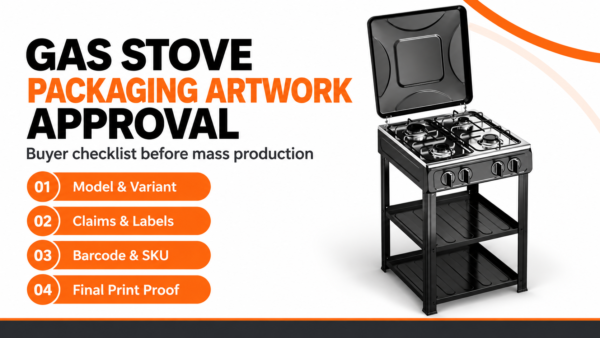
Four-burner gas stove with packaging artwork approval checklist for importers

Gas Stove Packaging Artwork Approval: Buyer Checklist

A gas stove can be built to the approved sample and still reach the market in the wrong box. A photograph may show another burner layout, a barcode may identify another SKU, or the language file may belong to a different destination. Once thousands of cartons are printed, a small artwork mismatch becomes a relabeling, repacking or shipment problem. For an importer, distributor or private-label brand, packaging approval should answer one release question: does this exact print file describe the exact product, contents and destination of the purchase order? Design quality matters, but the release also depends on controlled product evidence, verified copy, a current dieline, an identifiable proof and a record of who approved each part. This guide provides a quick-answer table, a four-file control set, a functional review workflow, a first-print check, common mistakes and a copy-ready approval record. Quick Answers for Gas Stove Importers Buyer question Quick answer When is retail-box artwork ready to print? When the final file matches the approved product variant, contents, destination, language set, barcode data and current dieline, with all required reviews closed. Is approving a PDF enough? Only when the approval identifies the exact filename and revision and the buyer has decided whether a physical or production proof is also required. Who should check gas-related and safety wording? Assign the relevant product and destination-market review to qualified people; a graphic designer should not be treated as the technical approver. Can one box be reused for several variants? Only after the buyer confirms that the product image, identifiers, claims, labels and market requirements remain correct for every intended variant. What should stop printing? Any unresolved mismatch in product identity, barcode, gas-related wording, included contents, required language, regulatory copy or dieline revision. The strongest release record separates what marketing approves from what product,
Read More »
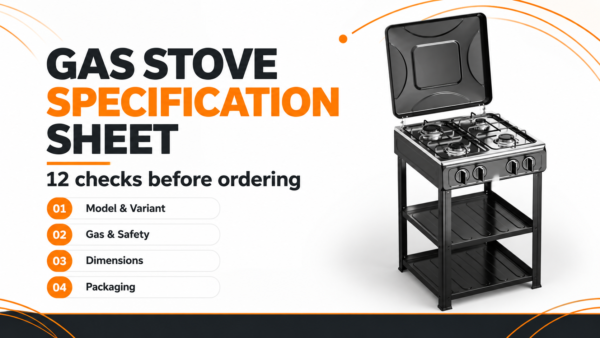
Four-burner gas stove beside a specification sheet checklist for importers

Gas Stove Specification Sheet: 12 Checks for Importers

A quotation can look complete while the supplier and buyer are pricing different products. One file may describe a three-burner body, another may show a different support or lid, and the packing figures may come from an older carton. If purchasing compares only model names and unit prices, these differences can surface after the sample, artwork or shipping plan has already been approved. For an importer, distributor or private-label buyer, a gas stove specification sheet should answer one question: can every team identify the exact configuration covered by the quotation, sample, documents and shipment? A useful sheet separates confirmed facts, selectable options and open fields, names the source for critical data, and carries a revision that can be linked to the purchase order. This guide provides a quick-answer table, twelve field checks, an evidence hierarchy, a supplier comparison method, common mismatch controls and a copy-ready request. Quick Answers for Gas Stove Importers Buyer question Quick answer Is a catalog page a final order specification? Usually no. It begins product selection, while the final order needs the exact variant, destination, gas configuration, packing and revision status. Which fields should stop quotation approval? Hold when product identity, destination, fuel or pressure basis, burner layout, critical options, packing basis or applicable document scope is unclear. How should unconfirmed data be shown? Mark it “to be verified,” assign an owner and evidence source, and close it before the milestone that depends on it. Can data from a similar model fill a blank? No. Similar appearance or family naming does not prove identical construction, gas configuration, dimensions, packing or document coverage. What makes two supplier quotations comparable? Both replies must describe the same requirement and state their exact configuration, inclusions, packing basis, assumptions and open points. A usable gas stove specification identifies the model and

Read More »
LPG vs natural gas stove

LPG vs Natural Gas Stove: Importer Guide for Gas Appliance Buyers

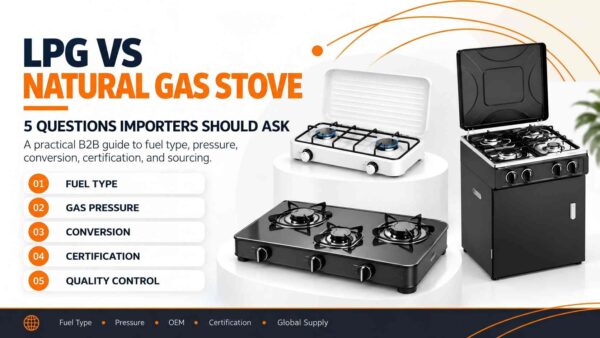
IMPORTER GUIDE LPG vs Natural Gas Stove: Importer Guide for Gas Appliance Buyers A practical guide to fuel configuration, pressure, certification, OEM manufacturing and quality control for international gas appliance buyers. Quick Answer: LPG stoves are generally configured for cylinder-supplied gas, while natural gas stoves are designed for pipeline-supplied gas. The two versions may require different injectors, valves, pressure settings, connections and certification documents. Introduction When comparing an LPG vs natural gas stove, importers need to evaluate more than fuel availability or consumer preference. LPG and natural gas appliances use different gas pressures, injector sizes, burner settings, valves, connection systems and documentation requirements. A stove designed for one fuel type cannot automatically be treated as suitable for the other. This issue is especially important for overseas importers, distributors, wholesalers, private-label brands and OEM purchasing managers. If the fuel specification is incorrect, the appliance may experience unstable flames, poor combustion, ignition problems, failed testing or customer complaints after shipment. These issues may also lead to relabeling, component replacement, delayed customs clearance or costly returns. The correct fuel configuration should be confirmed before the quotation, sample, packaging artwork and production schedule are approved. This guide explains the technical and commercial differences between LPG and natural gas stoves, how fuel type affects manufacturing, and what buyers should verify before placing a bulk order. LPG vs Natural Gas Stove: The Technical Difference An LPG stove is designed for liquefied petroleum gas, which is commonly supplied from a cylinder or tank. A natural gas stove is designed for pipeline-supplied gas. Although both appliances use burners to produce heat, their internal gas systems are not necessarily the same. Factor LPG Stove Natural Gas Stove Typical gas supply Cylinder or tank Pipeline Appliance pressure Usually higher Usually lower Injector opening Usually smaller Usually larger Typical applications Homes,

Read More »
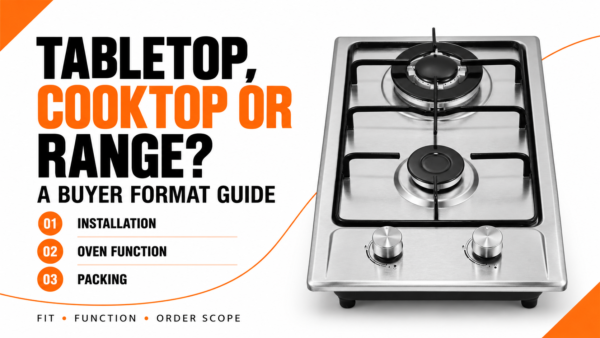
Buyer guide to tabletop stoves, built-in cooktops and ranges, illustrated with the stainless steel ECOBRIDGE 6201S cooktop, two burners and two silver knobs

Tabletop Gas Stove vs Gas Cooktop vs Gas Range: Buyer Guide

Choose a tabletop gas stove when the brief calls for surface cooking on a suitable existing support; choose a built-in gas cooktop when the kitchen can accommodate its specified countertop installation; choose a range when an integrated oven is part of the required appliance. For an importer, the first decision is what the customer must install and what cooking functions the delivered product must provide. Burner count comes later. A cabinet beneath the burners does not, by itself, establish that an oven is included. This guide compares the formats using current ECOBRIDGE model information, explains the installation and packing questions that change the choice, and provides a short selection sheet. It covers product selection; the burner-count guide addresses how many cooking positions to shortlist within a suitable format. Tabletop stove, built-in cooktop or range: what are you buying? In this comparison, tabletop describes a self-contained surface-cooking appliance placed on a suitable support. A built-in cooktop, also called a hob in some markets, is installed into a prepared countertop opening. A conventional range combines a cooking surface and oven in one appliance. Whirlpool’s range-versus-cooktop guide makes the oven distinction explicit. These terms still need to be tied to the actual offered model, because commercial listings use “stove” and “cooker” broadly. [5] On a phone, swipe or scroll the table sideways to read all columns. Start with the installation and function the customer needs Format What the brief must establish Reason to shortlist it Reason to hold the choice Tabletop gas stove Suitable support, usable space, connections and model instructions The customer needs surface cooking without a built-in countertop opening The proposal assumes any table or location is suitable without checking the instructions Built-in gas cooktop Countertop opening, support/sealing arrangement and installation access The kitchen design provides for an integrated cooking surface

Read More »
Gas stove burner comparison guide illustrated with ECOBRIDGE Model 6015, showing five burners, five front knobs and an open cover

1 vs 2 vs 3 vs 4 vs 5 Burner Gas Stove: Buyer Guide

For a gas stove burner comparison, choose the number of cooking positions that supports the buyer’s actual simultaneous cooking tasks, then check cookware space, the permitted installation or placement conditions, and the packed product. A fifth burner is useful only when the proposed layout gives the user an additional position they can use. A two-burner model can be the better shortlist choice when the extra positions add no value to the intended offer. For importers and distributors, the decision is therefore more specific than “Which burner count sells best?” Ask: Which exact model can serve our cooking brief within our space, configuration and landed-cost constraints? This guide compares one through five burners using documented ECOBRIDGE examples and provides a selection sheet that buyers can reuse. The dimensions and loading quantities below are supplier reference information, not independent measurements, cooking-test results or an order commitment. Start with a real model, not a burner-count tier A one-burner product offers one cooking position; adding positions can give the user more choices. It does not establish cookware capacity, heat output, portability, premium quality or suitability for a country. Compare products of the same intended format before deciding which count belongs in the range. The following examples show why that distinction matters. Models 6001–6004 are listed on printed page 06 of Gas Stove catalog 2026-04. The five-burner example comes from the published Model 6015 product specification. Dimensions are reproduced in the sources’ listed order; obtain a dimensioned drawing to confirm width, depth, height and the open-cover envelope for the ordered version. [1] [3] On a small screen, scroll the tables sideways to read every column. Documented examples for a first shortlist Cooking positions Example model Listed product size, mm What the buyer should investigate 1 6001 268 × 268 × 59 Whether a single cooking

Read More »
ECOBRIDGE Model 6003 three-burner gas stove on the container loading guide cover

Gas Stove Packaging and Container Loading Guide

Compare gas stove shipping proposals by the cost and quantity that can actually be delivered and received. Begin with finished outer cartons and units per carton, build the proposed load, then price packing, transport and unloading together. Use container volume for an initial screen and book against the approved load plan. For an importer, the practical question is often whether to ship loose cartons, accept a palletized proposal or change the order mix. The answer depends on the packing hierarchy and the receiving operation as well as the ocean-freight quote. A low container rate can still produce a high cost per saleable unit when the proposed load carries fewer units or the warehouse cannot unload it as planned. The calculations below use identified ECOBRIDGE packing references and clearly labeled fictional cost exercises. Each example keeps the tabletop stove and built-in cooktop on separate order lines. Measure the finished outer carton The April 2026 ECOBRIDGE catalog gives three dimensions for Model 6003. It lists the appliance, its color box and an outer carton containing eight units. Use the figures on PDF page 4, printed page 06, as a reference when requesting measurements of the finished order. Model 6003 packing hierarchy Record Listed dimensions Calculated volume How the buyer should use it Appliance 577 × 278 × 53 mm 0.008501518 m³ Use for appliance dimensions. Color box 595 × 70 × 335 mm 0.01395275 m³ Use for the individual retail box. Outer packing carton 595 × 345 × 610 mm; 8 units 0.12521775 m³ per carton Starting point for the carton census and shipment-volume calculation. Divide the outer-carton volume by eight to obtain 0.01565221875 m³ per unit for this reference pack. Using the bare appliance volume instead would understate that per-unit outer-pack allowance by about 45.7%. Even using the color-box volume would

Read More »
OEM gas stove guide for private label importers and distributors

OEM Gas Stove Guide: 5 Questions Private Label Buyers Should Ask Manufacturers

OEM Gas Stove Guide: 5 Questions Private Label Buyers Should Ask Manufacturers An OEM gas stove project involves much more than placing a logo on an existing appliance. For importers, distributors, wholesalers, retailers, and private-label appliance brands, customization can affect product appearance, gas configuration, burners, controls, labels, packaging, compliance, production cost, minimum order quantity, and lead time. A buyer may start with an existing factory model, but the final commercial product can become significantly different once branding, components, packaging, market requirements, and technical specifications are added. For this reason, private-label buyers should define the complete project before approving mass production. This guide answers five important questions buyers should ask an OEM gas stove manufacturer before developing a private-label product. Quick Answers for OEM Gas Stove Buyers Buyer Question Quick Answer What can be customized on an OEM gas stove? Depending on the model and order quantity, customization may include logos, colors, panels, glass printing, knobs, burners, pan supports, labels, manuals, cartons, and selected components. What is the MOQ for a private-label gas stove? There is no universal MOQ. It depends on the base model, customization depth, packaging, component requirements, printing, tooling, and supplier minimums. How does sample approval work? The buyer defines the specification, reviews a sample, requests revisions where needed, and approves a final production reference before mass production. What affects OEM gas stove cost? Base model, materials, burners, valves, ignition, safety components, packaging, branding, tooling, certification, and order quantity can all affect cost. How long does an OEM gas stove project take? Lead time depends on whether the project uses an existing platform or deeper customization, plus sampling, tooling, compliance, packaging, and component availability. The key principle is simple: An OEM quotation should be based on the final approved specification, not only on the appearance of the base

Read More »
gas stove certification

Gas Stove Certification Guide: 5 Questions Importers Should Ask Before Importing

Gas stove certification should be considered before mass production, not after finished appliances are packed and waiting for shipment. For importers, distributors, appliance wholesalers, retailers, and private-label brands, compliance is not simply a certificate supplied by a factory or a conformity mark printed on a product. The correct compliance route can depend on the destination country, appliance design, gas category, operating pressure, burner configuration, ignition system, safety functions, electrical components, applicable regulations, product labels, instructions, and the responsibilities of the economic operators involved. A gas stove suitable for one market should not automatically be assumed to meet the requirements of another. Likewise, documentation covering one model or configuration may not automatically apply to a modified OEM or private-label version. This gas stove certification guide answers five important questions importers should confirm before approving samples and placing bulk orders. Quick Answers for Gas Stove Importers Buyer Question Quick Answer What certifications are required for gas stoves? Requirements depend on the destination market, product configuration, gas specification, applicable regulations, and required conformity-assessment route. Are certification requirements the same worldwide? No. Markets can have different gas conditions, product rules, standards, markings, testing requirements, labels, and documentation. Is factory certification the same as product certification? No. Factory management or audit certificates do not automatically certify a specific gas stove model for a destination market. When should certification be confirmed? Ideally during product selection and sample development, before components, packaging, and mass production are finalized. What documents should importers check? Depending on the market, buyers may need to verify certificates, test reports, declarations, technical documents, labels, manuals, and inspection records. These questions help buyers move away from asking: “Do you have certification?” and toward the more useful question: “What compliance requirements apply to this exact gas stove in my destination market?” 1. What Certifications Are

Read More »
Gas stove quality control guide with ECOBRIDGE Model 6004C, a black four-burner tabletop stove with four silver front knobs and a raised ribbed lid

Gas Stove Quality Control: From Sample to Shipment

Gas stove quality control starts with an agreed product requirement and follows it through components, assembly, testing and packing. Before production, define where each important requirement will be checked, how the result will be recorded and what happens after a failure. Before shipment, review the evidence for the actual order. For an importer, distributor or private-label buyer, the useful deliverable is a control plan that the factory and inspector can work from. A list saying “appearance, leakage, ignition, packaging” identifies topics. It does not identify the correct version, test conditions, inspected population or release authority. Buyer decision rule: every important check needs a requirement, a method, a production stage, an identified result and an action for failure. Keep shipment approval open when required evidence or corrective work remains unresolved. In this guide Three QC decisions Follow the production route Read functional-test records Build a usable control plan Use final sampling correctly Record shipment release Separate product approval, production control and lot acceptance These three decisions need different evidence. Mixing them together is how an approved sample becomes the answer to a question about a later shipment. Product approval: what exact configuration is authorized for this order? Link the model and variant to the approved specification, component list, sample reference and artwork revisions. Production control: how will the factory keep that configuration consistent while making it? Identify checks at the points where components are received, work is performed and finished units are tested. Lot acceptance: does the identified shipment meet the agreed release criteria? Review the inspection findings together with the required production records and unresolved issues. ISO’s quality-management explanation describes a system of processes and procedures and distinguishes product inspection from assurance of the processes that deliver it. For the purchasing team, this supports assigning checks throughout production rather than

Read More »