A missing replacement part can turn a routine service request into a returned stove, a delayed distributor order or a customer who stops buying. Before placing a gas-stove purchase order, an importer needs to know which parts can be identified, which versions they fit, who can replace them, and how quickly they can be reordered. If those answers are missing, the spare-parts plan is still open—even if the supplier says that parts are available.
This guide gives importers and private-label teams a practical approval method: seven checks, a parts-schedule template, a way to estimate opening stock from sales forecasts and service data, and a supplier email they can send before order release. Use it alongside the approved sample and specification for the exact product and destination market.
Quick Answers for Gas Stove Importers
| Buyer question | Quick answer |
|---|---|
| When is a spare-parts plan ready? | When every promised item has a controlled identity, approved compatibility boundary, order unit, stock assumption, replenishment route and service responsibility for the exact production version. |
| Is a percentage of free spares enough? | No. A percentage does not define the item mix, calculation base, coverage period, compatibility or reorder process. |
| Can a photo prove that a part fits? | No. Photographs help identify visible versions, while fit and technical suitability require appropriate drawings, measurements, sample checks or engineering evidence. |
| Should every part be customer replaceable? | No. Separate consumer-handling items from parts that require an authorized or qualified service route, especially gas-carrying or safety-related components. |
| How should launch stock be calculated? | Use the expected installed population, available service history, resolution path, replenishment time and revision risk. State assumptions and review them when field data arrives. |
The buyer is approving a service system, not only a box of parts. The schedule needs to work for purchasing, warehouse, distributor support and the factory after the original container has shipped.
The purchasing decision: is the spare-parts plan ready to approve?
Approve it only when the parts list matches the signed sample, specification revision and destination market. A marketing model name alone is too broad. The final order may have different knobs, pan supports, burner components, lid or packaging from a previous lot. A photo that looks similar does not prove that a replacement fits or is suitable for the same gas configuration.
The buyer needs one document that purchasing, service, warehouse and factory teams can read the same way. Record the buyer SKU, factory model, market, sample approval date, purchase order and revision. If an item remains unverified, mark it “pending validation” rather than silently adding it to the service promise.
Seven checks for a usable gas-stove spare-parts schedule
1. Freeze the exact production version
Record the model and buyer SKU, approved specification, golden sample, destination country and the first production order covered by the schedule. Include visible identifiers such as burner count, body finish, pan supports, knobs and lid. Use photographs to identify the approved version, then ask for drawings or fit evidence before declaring a spare part compatible. An exterior photo cannot establish whether an internal component is interchangeable.
For a revised component, document the first affected order or production lot. Keep old versions available for servicing units already sold. Connect the schedule to the component change approval so a design change does not leave a stale service list behind.
2. Assign an unambiguous identity to every service item
“Silver knob” and “small burner” are not enough to order from. Request a supplier part code and revision, clear name, image from more than one angle, exploded-view position and dimensions at the mating points. Distinguish a complete assembly from a single component. State whether the purchasing unit is one piece, one pair, one full-stove set or one carton.
Ask which items can be replaced through the importer’s service channel and which require qualified technical work. A gas-carrying or safety-critical component should never be treated as consumer-installable merely because it appears on a parts spreadsheet.
3. Define compatibility and exclusions
Each line should say which model revisions and production lots it fits and, just as clearly, which it does not. The factory or engineering team should document a physical fit check against the approved golden sample, with measurements or photographs where appropriate. Appearance is a screening clue, not compatibility evidence.
If a part affects gas flow, ask for the technical details and approved gas configuration for the destination market before accepting substitution. Do not combine components from different gas categories or market versions because their exterior dimensions appear similar. Repeat the compatibility review whenever the component revision changes.
4. Separate launch stock from continuing stock
Launch stock covers early sales and the time until field demand is measurable. Continuing stock should be updated using actual service tickets, return reasons and replenishment time. A blanket “2% free spares” proposal does not tell the importer which parts are included, what population the percentage uses or how long it is supposed to cover. Ask the supplier to break quantities down by line item.
If there is no reliable service history, use a provisional range with stated assumptions. Review it after the first meaningful batch of sales, then revise the part mix before the next order. Ask whether individual parts can be supplied later, what their pack sizes are and how discontinued revisions will be handled. These are RFQ questions, not claims about ECOBRIDGE availability.
5. Define the reorder trigger
For each stocked line, record the reorder point, expected demand during replenishment and an agreed buffer. A transparent planning formula is reorder point = expected demand during replenishment time + buffer. Demand, supply time and buffer should appear as editable assumptions in the buyer’s sheet. There is no universal buffer percentage.
Confirm ordering contact, purchase-order format, unit of measure, packing unit, quote basis, labeling and shipment route. The warehouse should see the buyer SKU and part code on the packet or carton. A part called “support A” in an email is difficult to pick consistently a year later.
6. Agree on a claim-evidence workflow
Specify what the distributor submits for a claim: model, order reference, production lot if available, photographs of the whole product and affected area, symptom, installation context and date observed. Agree who decides whether the resolution is a part, replacement unit, credit or investigation. The process is separate from any warranty promise; the warranty term must be confirmed for the order.
Track outcomes by defect code. If repeated claims cluster around one part, review the affected lots and root cause. Sending additional spares may help service customers but does not prove that the production problem has been corrected.
7. Control revisions across manuals and packaging
The consumer manual, carton, product label, specification and service list should refer to the same approved configuration. If an OEM feature changes, update the packaging artwork release and specification-sheet record along with the spare-parts schedule. Record what changed, why, who approved it, the first affected lot, and whether an earlier part remains usable.
Do not overwrite a historical PDF without a revision log. A distributor may need to service both old and new units in the same market.
Buyer-ready schedule: fields to request
The table below is a request template. It is not a published ECOBRIDGE parts list. Part numbers, compatibility and quantities must come from the approved order documents.
| Field | What the supplier should provide | Buyer release test |
|---|---|---|
| Product identity | Model, buyer SKU, market, specification and sample revision | Matches the purchase order |
| Part identity | Code, revision, name, photo or drawing position | Warehouse can pick one exact item |
| Fit boundary | Applicable and excluded versions or lots | Fit has been approved |
| Order unit | Piece, set or carton; units per pack | Quote and PO use the same unit |
| Stock plan | Launch quantity, forecast basis and review date | Assumptions are traceable |
| Replenishment | Order route, quoted supply time, reorder trigger | Service team knows how to reorder |
| Service control | Replacement responsibility and claim evidence | Resolution path is agreed |
Request one fully completed sample line before reviewing a long spreadsheet. A sample exposes unclear units and compatibility claims faster than an empty template. If the factory cannot yet confirm a fit, keep that row open.
Which spare parts should the buyer discuss first?
Prioritize by likely field demand, service consequence, supply time and variant risk. A first discussion may cover pan supports, knobs, burner-related items, feet, lids or hinges, plus labels or packaging items that affect returns. This is a discussion list, not a claim that every item is individually stocked or offered for every configuration. Gas-related and safety-critical components require technical review and a market-appropriate service route.
Ask the factory which items have historically been requested for the approved configuration, then compare that with your distributor’s return reasons. Keep customer-handling items separate from qualified-service parts. The classification must be validated for the actual stove and market.
Estimate starting quantities without inventing a fixed percentage
Model low, base and high demand for each candidate part. State the number of units expected in the market before replenishment, an assumed incident rate, the share of incidents resolved by that part, and the time to receive more stock. The output is a range, not a claim about factory defect rates. Document the chosen launch quantity and the review date.
| Question | Why it matters | Evidence |
|---|---|---|
| How many units will be active? | Defines the exposed population | Sales and shipment forecast |
| What issues appeared in comparable units? | Changes the mix of parts | Return codes and service tickets |
| Can the issue be repaired locally? | Changes part demand | Approved service procedure |
| How long does replenishment take? | Changes stockout exposure | Supplier quote and transport plan |
| Will a revision change? | Creates obsolete-stock risk | Change notice and fit decision |
Revisit the assumptions after field data arrives and before each repeat container. A one-time “free spares” negotiation is not a continuing support plan.
Seven warning signs in a supplier reply
- Only a generic product photo is supplied, with no part code.
- One part is said to fit every model without revision limits.
- A quantity is given only as a percentage, with no base or period.
- “One set” is quoted without defining its contents.
- A component changed but the service schedule did not.
- Availability is promised without a documented ordering route.
- Claims are handled only in informal chat and cannot be tied to a lot.
These are questions to resolve before the purchase order creates a service obligation. They are not automatic reasons to reject a factory.
Email template: request the controlled parts schedule
Subject: Spare-parts schedule for [model / buyer SKU / market / PO]
Hello [supplier contact],
Before we release PO [number], please send a version-controlled spare-parts schedule for the approved sample and specification revision [revision]. For each serviceable item, include its code and revision, photo or drawing, applicable production versions, excluded versions, ordering unit, units per pack, proposed launch quantity, quote basis, replenishment process and replacement responsibility.
Please flag any gas-related or safety-critical item that needs technical review or qualified installation. Identify compatibility that is still pending rather than assuming interchangeability. Tell us how changes will be notified and how units from earlier production lots will be supported.
Please complete one example row and attach the applicable approval record. We will compare the schedule with our sample, packaging artwork and service policy before confirming quantities.
Regards,
[buyer name / company]
Purchasing release checklist
- The schedule uses the same model, market and revision as the PO.
- Every ordered item has a unique code and clear image.
- Fit limits and exclusions are explicit.
- Gas-related items have a separate technical and service review.
- Stock quantities have documented assumptions and a review date.
- Pack unit, quote basis, supply route and reorder trigger are agreed.
- Claims can be traced to an order and production lot.
- Component changes create a new schedule revision.
For each unanswered item, record an owner and due date. Keep the approved schedule with the golden-sample record and purchase file.
Example: a product photo is not a spare-parts list
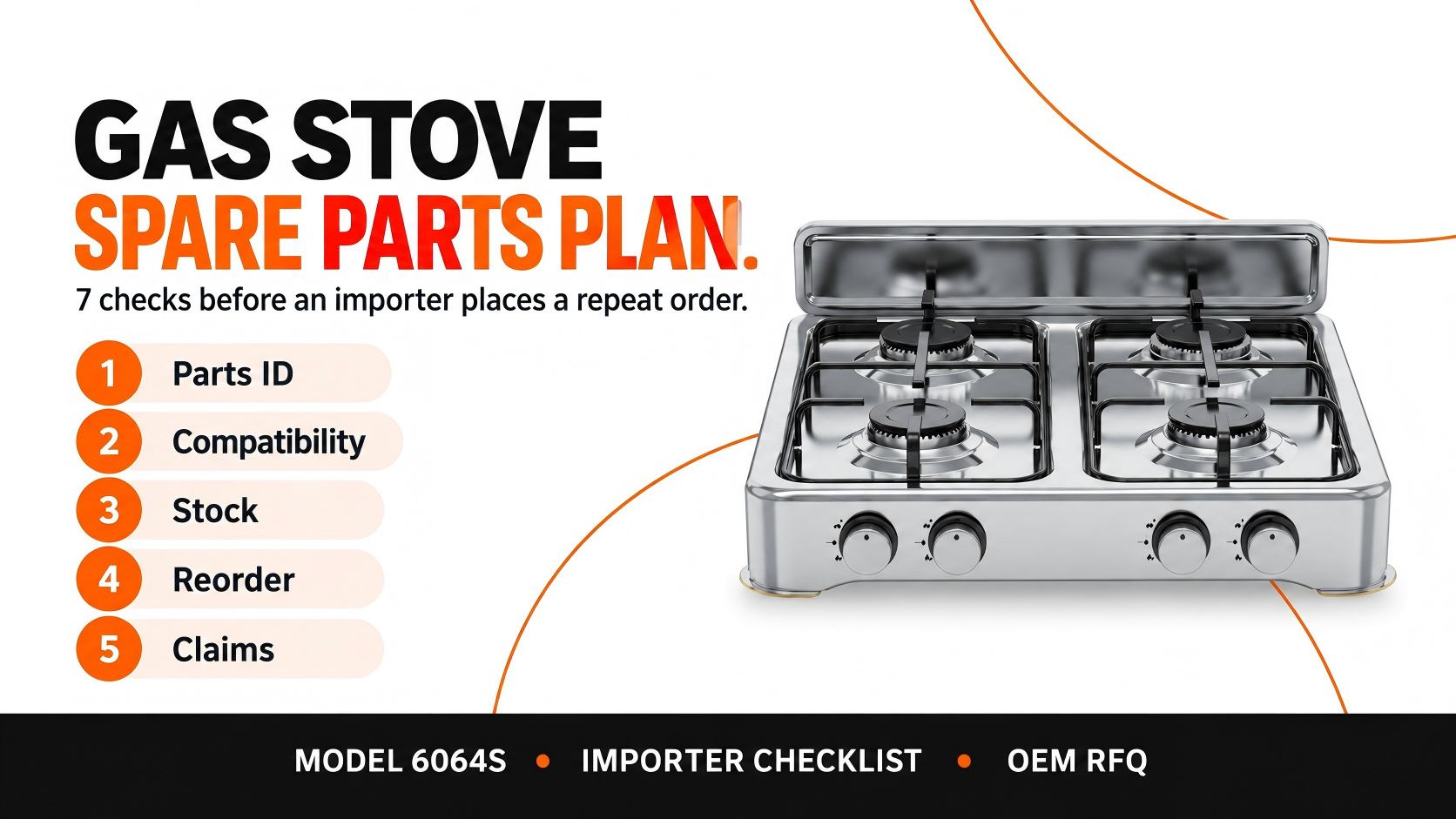
The ECOBRIDGE April 2026 catalog identifies model 6064S as a four-burner gas cooker. Its real media-library photo shows four burners, two black pan-support grids, four front knobs, a silver tabletop body and a hinged rear lid. That is enough to describe the pictured configuration accurately. It is not a spare-parts map: neither the catalog entry nor the image identifies service part codes, proves fit across production revisions, or establishes what the supplier will stock. This gap is exactly why the buyer needs the controlled parts schedule before promising after-sales support.
A buyer receiving only this catalog page and product photo should ask for the approved parts schedule before promising replacements to a distributor. For gas-related parts, request current documentation for the exact product and destination market. The gas-stove certification guide provides a separate document-check framework.
Common Gas Stove Spare-Parts Planning Mistakes
Mistake 1: Asking only for “common spare parts”
The phrase does not identify the product revision, destination or service responsibility. Send the approved order reference and request a line-by-line schedule.
Mistake 2: Treating visual similarity as compatibility
Two knobs, burners or supports may look alike while having different mating dimensions or technical requirements. Keep compatibility pending until the supplier provides suitable evidence for the exact version.
Mistake 3: Accepting one percentage for every item
Different parts have different field demand, consequences, supply times and obsolescence risks. Record the assumption for each stocked line and set a review date.
Mistake 4: Forgetting old production revisions
A distributor may need to service units from several lots. A component change record should state whether the new item replaces, coexists with or excludes the earlier version.
Mistake 5: Leaving the service route undefined
Availability does not mean an end user should install a part. Record who diagnoses the issue, who performs replacement and what evidence is required.
Mistake 6: Promising warranty terms through a parts list
A stocking schedule and a warranty agreement answer different questions. Confirm claim eligibility, time limits, remedies and responsibilities in the order-specific commercial documents.
Frequently Asked Questions About Gas Stove Spare Parts
Which parts should an importer stock first?
Prioritize from the approved configuration, expected field demand, service impact, local repair capability, replenishment time and revision risk. Do not publish a universal list without project evidence.
Can spare parts ship with the main order?
Ask the supplier to confirm the proposed items, quantities, packing, labeling, commercial basis and shipment arrangement for the actual order. The schedule should distinguish launch stock from later replenishment.
What if the supplier has no historical failure data?
Use a provisional range with clearly stated assumptions. Review service tickets and return reasons after the first sales period, then change the mix before the next order.
How should a buyer handle discontinued parts?
Request advance change notice, the last affected production lot, remaining supply information and a documented decision on any replacement part. Confirm compatibility rather than assuming supersession.
Final Answer: What Should Importers Approve?
Approve a spare-parts plan only when it is tied to the exact purchased version and can be operated after shipment. Each promised item needs a unique identity, compatibility scope, ordering unit, stock rationale, replenishment route, service classification and change history. Open fields should remain marked for validation instead of becoming an unsupported sales promise.
Before releasing the purchase order, make purchasing, warehouse, distributor support and the supplier review the same controlled schedule. Reopen it whenever the product, component, packaging, service route or production revision changes.
Send a specific RFQ
Share your destination country, preferred model or product image, expected order volume, buyer SKU or brand requirement, sample status, service approach and the spare-parts fields needing confirmation. Request the final specification, current technical documents, controlled parts list, packaging proposal and commercial quotation for your configuration. Contact ECOBRIDGE with your RFQ and ask the sales team to identify unresolved compatibility and supply terms in its reply.
Source note: The 6064S four-burner description comes from the supplier’s April 2026 Gas Stove catalog; visible features were checked against the website media-library photo. The catalog and photo establish product identity, but do not verify spare-part compatibility. Part codes, quantities, prices, supply times and warranty terms require order-specific confirmation.
 English
  Spanish
  Portuguese
  French
  Dutch
Dutch  Bengali
  Russian
  Arabic