

Choose a gas stove pallet plan from the receiving warehouse’s limits and the finished carton, then validate the complete load. A carton that fits inside a pallet outline has passed a geometry check. It still needs a support, stacking and handling review before it becomes a shipping specification.
That distinction matters when a distributor asks for “standard pallets.” Standard for which warehouse, handling equipment and delivery route? The useful output is a drawing and load sheet that the supplier, forwarder and receiver can all use. A catalog’s container quantity does not supply that information.
This guide works through a nominal carton example for ECOBRIDGE Model 6504S and shows which calculations a buyer can complete immediately, which inputs remain open, and how to avoid confusing a layer layout with an approved unit load.
Start at the receiving dock, before choosing a pallet
Ask the receiving warehouse for its pallet and unloading requirements while the order is still being planned. Record the accepted outer footprint, maximum finished height and gross mass, permitted pallet types, entry requirements for handling equipment, and whether mixed SKUs are accepted on one pallet.
Keep those answers separate from the supplier’s proposed packing. For example, a warehouse may accept only an 800 × 1200 mm footprint. A supplier’s more space-efficient 1000 × 1200 mm layout is then a different delivery proposal, even if it carries more cartons per layer. The buyer needs either a compatible plan or explicit receiver acceptance of the alternative.
Also distinguish unloading from storage. A pallet that can be taken from a vehicle may still need a separate review for the warehouse’s intended storage arrangement. Write down where the load will go after the dock instead of treating “forklift available” as the complete receiving brief.
For a first comparison, return one short receiving specification: destination and route; allowed pallet type and dimensions; finished height and mass limits; handling and storage method; and the person who can accept a deviation. This is the input to the design, rather than another checklist to complete after packing.
The 6504S carton: one nominal layer, two different results
The ECOBRIDGE 6504S product page, rechecked on 2 November 2026, lists a 910 × 550 × 140 mm carton and one unit per carton. These are product-page packing references. Obtain the current packing drawing and approved orientation for the actual order before using them for shipment release.
For this editorial calculation, place that carton flat, with a 910 × 550 mm base and 140 mm height. Rotate it only within the horizontal plane. Do not assume that turning the carton onto its side is allowed.
EPAL’s official overview identifies an 800 × 1200 mm Euro pallet and a 1000 × 1200 mm EPAL 3 pallet. We use those nominal outer footprints for comparison. They do not establish the usable deck support or capacity of any pallet offered by a supplier.
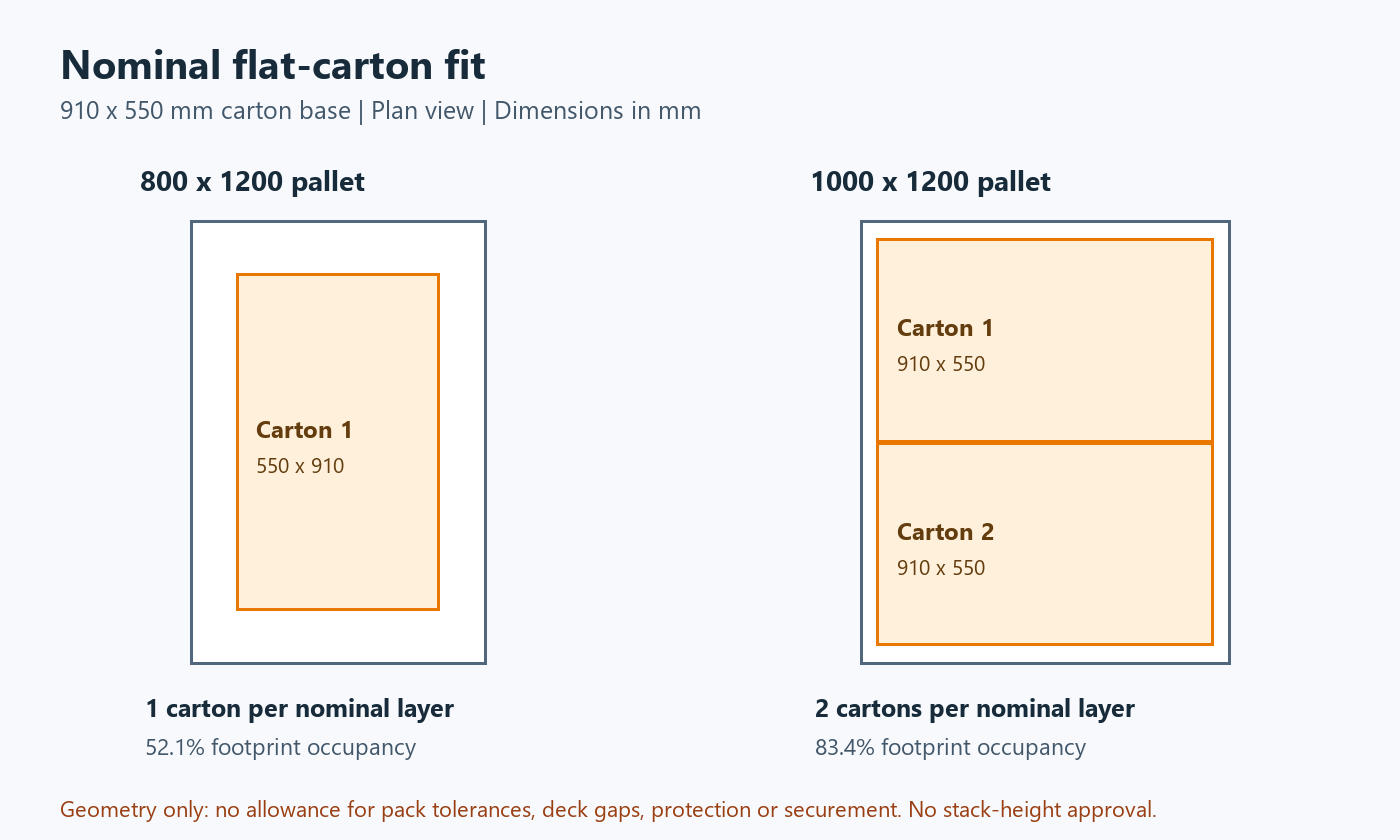
On an 800 × 1200 mm footprint
One carton fits geometrically with its 550 mm side across the 800 mm dimension and its 910 mm side along the 1200 mm dimension. The nominal unused total width is 250 mm and unused total length is 290 mm.
Two flat cartons cannot fit without overlap or overhang: their combined base area is 2 × 910 × 550 = 1,001,000 mm², which exceeds the pallet’s 960,000 mm² outline. This area check rules out two cartons even before considering their arrangement.
On a 1000 × 1200 mm footprint
Two cartons can fit geometrically: put each 910 mm side across the 1000 mm dimension, and place the two 550 mm sides consecutively along the 1200 mm dimension. The combined rectangle is 910 × 1100 mm. Nominal unused total width is 90 mm and unused total length is 100 mm. Those are total allowances across the footprint, not clearances on every side. Check the finished carton, any bulging, corner protection and wrapping before relying on the nominal fit.
A third flat carton is excluded by area: 3 × 910 × 550 = 1,501,500 mm², greater than 1,200,000 mm². The nominal maximum is therefore two cartons per layer under these assumptions.
The occupied footprint is about 52.1% in the first layout and 83.4% in the second. These percentages describe two-dimensional geometry only. They do not describe container utilization, damage probability or a validated number of units per pallet.
What still separates the drawing from a shipping specification?
The practical packing benchmark is FedEx’s illustrated pallet guide. It treats pallet choice, stacking, securement and labeling as connected decisions. It highlights strength and stiffness, handling compatibility, carton alignment, protection and unitization. Its current page serves air and parcel customers and directs LTL customers elsewhere; it is not an ocean-freight specification for this appliance.
Use those issues to structure an order-specific discussion with the pack designer. In the example above, ask where the carton actually bears on the deck, what protects it from deck gaps and contact points, and how the assembled load remains supported during the planned moves. A full rectangle on a drawing does not show the boards beneath it.
Then request the permitted stack and restraint arrangement for that carton revision. The designer should connect the proposed layers and protection to the expected route and handling conditions. Agree how the proposal will be evaluated and what condition is acceptable after that evaluation. Use the transport-packaging approval guide for the separate packing-trial and release decision.
Do not invent a layer limit by dividing a vehicle’s internal height by 140 mm. That produces a height-only ceiling, without answering whether the cartons can support the stack, whether the load remains stable, or whether the receiver accepts it.
Calculate the complete unit load
Once the approved layer arrangement and count are known, calculate and then check the finished load:
- Cartons: sum the cartons actually placed in each layer. Use a separate count for an incomplete top layer.
- Units: multiply each SKU’s carton count by its confirmed units per carton, then reconcile the SKU totals to the order.
- Height: include the actual pallet, carton layers, interlayers, top protection and any other height additions.
- Gross mass: include all packed cartons, pallet and securement materials. State the measurement or calculation basis.
For a uniform full-layer layout, the preliminary height expression is H = pallet height + L × carton height + added protection height. L is the approved layer count, not a value established by this guide. If materials compress or parts project beyond that expression, measure the finished load instead of treating arithmetic as the final dimension.
A similar distinction applies to space estimates. One carton occupies 0.910 × 0.550 × 0.140 = 0.07007 m³ as a nominal rectangular envelope. Two occupy 0.14014 m³. Neither value includes the pallet, protection or unused space around the cartons. Do not book palletized freight using only the sum of carton volumes.
A mixed shipment needs a location map and a quantity check
Mixing models should solve a stated receiving or distribution need. Before attempting a mixed layer, compare the actual outer cartons, permitted orientations and approved load arrangement for each SKU. Similar-looking appliances do not establish compatible shipping packs.
On a small screen, scroll each table sideways to read every column.
The following is a fictional receiving exercise, not an ECOBRIDGE shipment or stacking recommendation. The order contains 120 units of SKU A and 20 units of SKU B, both assumed to be packed one per carton for this exercise. A proposed manifest reads:
| Pallet IDs | Cartons per pallet | Extended quantity |
|---|---|---|
| A01–A19 | 6 cartons of A | 114 A |
| M01 | 6 cartons of A + 4 cartons of B | 6 A + 4 B |
| B01–B02 | 8 cartons of B | 16 B |
The totals reconcile to 120 A and 20 B across 22 pallet IDs. That establishes quantity agreement only. It does not approve any listed load pattern.
Suppose the warehouse does not accept mixed-SKU pallets. M01 fails that receiving rule even though the order totals are correct. The planner must revise the allocation and approved load drawings, or obtain acceptance of a different receiving proposal. Quietly changing the label to “assorted stoves” does not solve it.
If mixed pallets are accepted, map SKU positions on M01 so the receiving team can locate and count each item. Keep the pallet ID, carton labels and packing-list row connected. An unexplained residual quantity on a mixed pallet can otherwise become a receiving discrepancy even when every ordered carton was shipped.
Evaluate two questions separately: does the finished physical load meet the approved design, and does the manifest tell the receiver exactly what is on it? A correct total cannot repair an unsuitable stack; an acceptable stack cannot repair an incorrect SKU allocation.
A buyer load sheet with the known and open fields visible
Copy this example into the shipment planning file. The filled geometry fields are calculations from the stated nominal references. Open fields deliberately prevent the preliminary layout from being mistaken for release approval.
| Field | Current entry | What closes the field? |
|---|---|---|
| Product and carton | 6504S; reference carton 910 × 550 × 140 mm; 1 unit/carton | Current order packing drawing and measured finished carton |
| Orientation | Flat orientation assumed for the illustration | Pack designer’s permitted orientation |
| Pallet footprint | 1000 × 1200 mm comparison option | Receiver acceptance and exact pallet specification |
| Nominal full layer | 2 cartons; combined rectangle 910 × 1100 mm | Deck-support drawing and actual pack/protection allowances |
| Layers and top layer | Open; no layer limit supplied | Approved stack arrangement and evaluation evidence |
| Units per pallet | Open; 2L only for L identical full layers | Final layer-by-layer carton count |
| Finished height and mass | Open | Complete unit-load measurement and receiver/carrier limits |
| Protection and restraint | Open | Material specification, arrangement and verification record |
| Mixed-SKU allocation | Open if required | Accepted SKU map, carton counts and pallet IDs |
| Release | Not released | Named approval of the complete load for the stated route |
Use the sheet during the supplier discussion, then replace preliminary references with the approved order values. When the carton, pallet or route changes, identify which fields need another review. Avoid carrying forward an old pallet count merely because the appliance model name is unchanged.
Check wood-packaging requirements for the actual destination
For shipments entering or transiting the United States, USDA APHIS’s wood-packaging guidance, last modified 27 July 2026, covers regulated wood packaging including pallets and dunnage. It explains treatment and marking requirements, sourcing from accredited providers, and inspections for marks and pest evidence.
Identify the pallet and any additional wood packaging in the proposed load. Obtain the relevant provider details and legible marking evidence for review. A mark in an unrelated supplier photograph does not identify the pallet under the shipment.
The APHIS page also lists alternatives outside its wood-packaging regulation, including plastic pallets and certain processed materials. That regulatory distinction does not select a mechanically suitable pallet. Check the actual material and construction with the responsible parties; use the destination’s authority for routes outside this U.S. scope.
Before requesting a palletized offer, send ECOBRIDGE the receiving specification, model and quantities, intended route, and required carton protection. Ask for a proposed layer drawing and complete unit-load dimensions, mass and allocation. Once those inputs are agreed, use the container-loading guide for the broader shipment calculation, or discuss the packing proposal with ECOBRIDGE.
Sources and scope
- ECOBRIDGE, 6504S product page. Rechecked 2 November 2026; packing references, not approved pallet data.
- EPAL, Load carriers overview. Read 2 November 2026; named pallet dimensions only.
- FedEx, How to ship using pallets. Read 2 November 2026; carrier-specific practical guidance, not an appliance test or ocean-freight specification.
- USDA APHIS, Import ISPM 15-Compliant Wood Packaging Material into the United States. Read 2 November 2026; last modified 27 July 2026; U.S. entry/transit scope.
The layer geometry and receiving exercise are editorial calculations and recommendations. No validated ECOBRIDGE pallet stack, customer shipment result or carrier approval is claimed.