
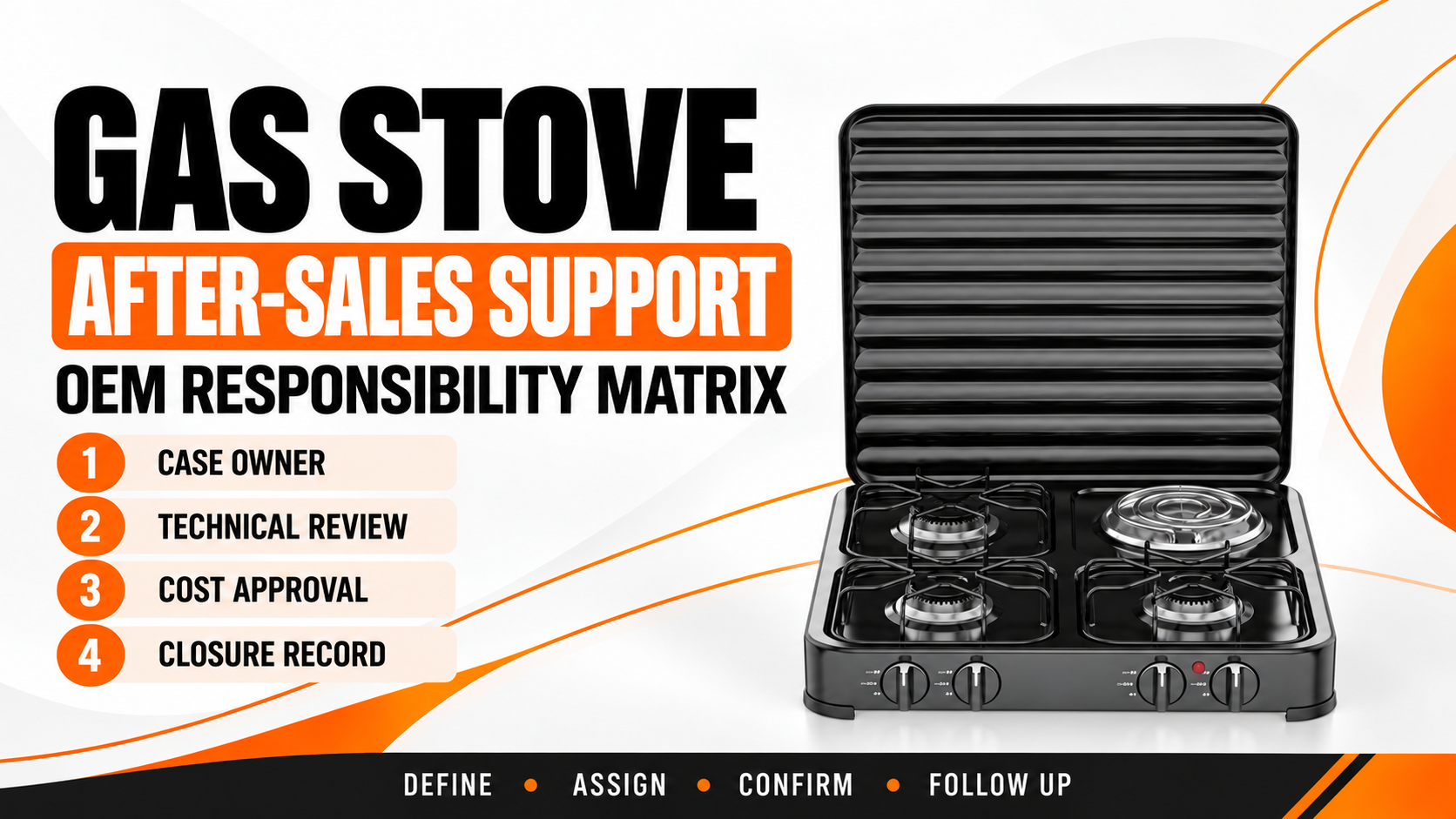
Before approving gas stove after-sales support for an OEM order, identify who receives a case, who can make the technical decision, who approves the proposed cost and who confirms closure. “Contact the factory” leaves those responsibilities open. The buyer’s release rule is to agree a named route for the exact product and market, supported by the files each decision maker needs. Keep an unresolved responsibility visible before making a promise to distributors or customers.
This guide helps importers, wholesalers, distributors and private-label purchasing teams prepare a service responsibility matrix before order release. It includes a real ECOBRIDGE catalog example showing why the number of visible cooking positions cannot, by itself, identify every assembly’s function or service route. The tools below are templates for agreement, not statements of ECOBRIDGE warranty coverage, parts availability or response commitments.
Quick answers for OEM buyers
On a small screen, scroll the tables sideways to read all columns.
| Buyer question | Working answer | Record to request |
|---|---|---|
| Does a service contact establish support scope? | No. Define what that contact receives, decides and passes to another reviewer. | Responsibility matrix and escalation route |
| Does a product photo identify all technical functions? | It shows visible features. Function, compatibility and permitted work require the applicable technical records. | Confirmed assembly map and service instructions |
| Does sending a part close a case? | Only if the agreed resolution and verification are complete and the closure owner accepts them. | Resolution and closure record |
| Should service targets be assumed? | No. Agree separate acknowledgement, assessment, decision and fulfilment checkpoints. | Named owner and confirmed review dates |
| Is this the warranty agreement? | No. Connect the operating workflow to the applicable commercial terms without inventing coverage. | Order-specific terms reference and approval route |
1. Separate the four decisions hidden inside “support”
Case ownership
The case owner keeps the record moving. That person checks whether the product can be identified, gathers missing documents, records the next action and tells the distributor what is awaiting review. The case owner does not automatically have authority to diagnose a technical cause or approve a credit. Name a backup so a case does not depend on one inbox.
Technical authority
The technical reviewer identifies which evidence applies to the affected assembly and decides what further assessment is needed. A sales contact may coordinate that review without being its technical approver. Record the reviewer’s role, the product versions covered and the route to suitable local service expertise where needed.
Commercial approval and closure
Keep the person who approves a proposed expense or remedy identifiable. Then name the person who accepts the completed outcome and records any remaining follow-up. These roles may be held by the same person in a small team, but the decisions should remain distinguishable. An acknowledgement is not a diagnosis; a proposed remedy is not an approved expense; dispatch is not verified closure.
This boundary keeps the discussion practical. The buyer can ask for a completed process line instead of accepting a broad assurance such as “we provide good after-sales service.”
2. A real catalog example: visible positions need a technical map
ECOBRIDGE’s Gas Stove catalog 2026-04, PDF page 8, printed page 13, presents three 600D-series entries. The illustrations show dark-capped cooking assemblies alongside a distinct bright silver circular assembly. The captions use gas-burner counts that differ from the total number of visible cooking positions.
| Catalog entry | Caption recorded in the source | Visible illustration observation | Service confirmation needed |
|---|---|---|---|
| 6002LBD1-1 | “1-Burner Gas Cooker” | Two cooking positions and two front controls; one assembly is bright silver and circular | Identify each assembly and its applicable technical reference |
| 6003BD1-1 | “2-Burner Gas Cooker” | Three cooking positions and three front controls; one assembly is bright silver and circular | Confirm which control and service document applies to each position |
| 6004BD1-1 | “3-Burner Gas Cooker” | Four cooking positions and four front controls; one assembly is bright silver and circular | Confirm the fourth assembly’s function and the responsible technical review route |
These observations do not establish that a caption is wrong. Nor does the silver assembly’s appearance establish its energy source, electrical specification, replacement method or compatibility. The useful purchasing insight is that counting visible positions and calling them all gas burners would skip a technical question. An unconfirmed assembly should not be assigned a service procedure based on appearance.
For a support inquiry concerning 6004BD1-1, request an annotated, approved assembly map that connects each position and control to its function, part or assembly reference and applicable instructions. Ask the supplier to identify which documents govern the actual ordered version. Keep the catalog image as an orientation aid, with its limitations recorded.
The reviewed catalog page does not supply a case owner, service-part codes, cost authorization or a response commitment. Those require separate project records. No delivered-unit inspection or service incident is reported in this example.
3. Build a responsibility matrix that produces a handover
Use one row per decision, with an input, an owner and a required output. “Supplier handles it” is incomplete if the distributor does not know what to submit or which decision comes next. The following roles are proposals to discuss, not an allocation of contractual or statutory responsibility.
| Decision or task | Proposed role to name | Input required | Handover output |
|---|---|---|---|
| Register and acknowledge | Buyer or distributor case coordinator | Case ID, product identity, neutral observation and files received | Case accepted for review; missing-information list and next checkpoint |
| Resolve identity and reference gaps | Supplier product-document owner, with buyer SKU owner | Full model, order, variant, lot where available and competing references | Confirmed applicability map or clearly stated unresolved gap |
| Assess the technical question | Named technical reviewer and suitable local service contact | Applicable assembly records and permitted assessment evidence | Documented finding, further information request or proposed technical route |
| Approve the proposed remedy and cost | Named buyer and supplier commercial approvers | Technical proposal, applicable terms and itemized cost scope | Written decision with exclusions, conditions and authorization reference |
| Fulfil the agreed action | Named parts, logistics or service coordinator | Approved item identity, quantity, destination and handling route | Traceable dispatch or service record and next verification step |
| Verify and close | Named closure reviewer | Agreed completion evidence and outstanding actions | Accepted closure, qualified partial closure or further work assigned |
Add actual names, contact channels, backups and review dates in the working version. A handover is complete when the receiving owner has the agreed files and accepts the next action. Copying someone into an email does not necessarily confirm that acceptance.
4. Define technical boundaries before discussing replacement
Identify the affected assembly
Record the position and control reference as well as the model. In the 6004BD1-1 example, “right-side problem” could refer to different visible assemblies. Use an annotated overview and a separate detail image so the technical reviewer can locate the question. Retain the original images alongside marked copies.
Ask who confirms the assembly’s function, the applicable production revision and whether a proposed replacement is an approved match. A visually similar part or a shared model prefix is insufficient evidence. The gas stove spare-parts plan covers part identity, compatibility and replenishment planning in more detail; the responsibility matrix names who must supply and approve those answers.
Agree the permitted service route
Separate customer-facing information from work requiring the appropriate technical personnel and instructions. Do not turn a catalog picture into a disassembly, gas-adjustment or electrical-testing procedure. For a possible safety concern, use the applicable product instructions and qualified local route, with the responsible technical contact identified. This guide supplies no repair procedure or universal qualification rule.
Ask how the team records a case when the technical boundary is still unknown. “Awaiting qualified assessment” is a useful explicit status; an incomplete assessment should not become an implied pass.
5. Agree the minimum file set and communication route
The support pack should connect the buyer SKU and supplier model to the order, approved configuration, available traceability and applicable documents. Include controlled product images, the assembly map, relevant service references and the customer-facing manual. Keep historical revisions accessible for products already supplied.
For an actual incident, agree what the first notice contains: observed condition, date, product identity, order reference, known quantity and an index of the evidence received. Keep suspected causes separate from confirmed findings. Use the gas stove quality issue report for the detailed evidence packet. This service agreement decides who reviews that packet and what happens when information is missing.
Decide which channel holds the authoritative case record. If discussion occurs in messaging apps, transfer decisions and their supporting files into that record. Identify the languages used for technical review and customer communication, and who checks that a translated message preserves the approved meaning.
The instruction manual localization guide helps connect the released manual, model applicability and service contact. Confirm which team updates a contact or document revision after release so that a new support route does not leave old instructions in circulation.
6. Confirm checkpoints and cost decisions separately
A response target is useful only when the event it measures is clear. Acknowledging receipt, requesting missing information, completing technical review, approving a remedy and delivering an item are different checkpoints. Ask the parties to confirm realistic targets and the conditions affecting each; this article assigns no standard number of hours or days.
Record the working calendar and time zone, when a case is considered complete enough for assessment, who reports a delay and when the next review occurs. A review date is a commitment to revisit the case, not an invented promise that the technical issue will be resolved by then.
| Item to clarify | Question for the parties | Evidence to retain |
|---|---|---|
| Parts or replacement unit | Who approves the item, quantity, charge basis and compatibility? | Approved proposal and identified item list |
| Assessment or service work | Who authorizes the scope before work or expense is incurred? | Scope, approver and authorization reference |
| Freight and local handling | Which transport, handling or other charges are included in the proposal? | Itemized allocation and agreed shipment route |
| Returned goods or retained samples | Who decides whether a return is needed and provides instructions? | Return authorization or sample-retention agreement |
| Customer communication | Who approves what the distributor may promise while review is open? | Approved wording and next-update date |
Keep the operating process linked to the applicable order terms. Accepting a case for review does not settle its cause, coverage or cost. Likewise, a service arrangement should not be presented as determining or removing any obligations that may apply in the destination market; obtain the appropriate review for those questions.
7. Run a document-only handover exercise before launch
Test the matrix with a hypothetical inquiry, without treating it as a real defect or carrying out a repair. For example: “The distributor has a 6004BD1-1 reference and asks about the bright silver circular assembly shown in the catalog. Its function and governing service document have not yet been confirmed.”
The coordinator should identify the missing technical reference, route the question to the named document and technical owners, and record what the distributor can be told meanwhile. The exercise should not end with an assumed energy source, a generic troubleshooting message or an unidentified spare part.
| Exercise step | Expected output to agree | Gap exposed if missing |
|---|---|---|
| Locate the product | Full model and buyer SKU linked to the applicable order and version | The contact knows a family name but cannot identify the service record |
| Route the assembly question | Named technical reviewer and request for the approved assembly map | A visible position is assigned a function from appearance alone |
| Communicate the pending status | Approved customer message, missing files and next checkpoint | The distributor makes a remedy or timing promise before approval |
| Accept the handover | Receiving owner confirms the next action in the case record | The case has been forwarded but no one owns it |
Record the exercise result as a process check. It is not evidence of technical performance, successful field service or customer satisfaction. Close any ownership gaps before relying on the route in a launch plan.
8. Define closure and the feedback into purchasing
Agree what completion evidence each type of action requires and who reviews it. The record should distinguish a part dispatched, a service action completed, an outcome verified and a commercial matter settled. If only one part of the case is complete, identify the remaining owner and review date.
When service findings indicate a document or product change, send the evidence to the responsible product and purchasing owners. Record which versions or orders are affected and what updates are approved. A resolved individual case does not establish that a production cause has been corrected or that all other units share the same condition.
Use actual cases to improve the next support agreement. Track missing-reference questions, incomplete handovers and repeated information requests separately from technical findings. Do not manufacture a failure rate or service performance statistic from a small, undefined set of messages.
Common mistakes before approving support
- Naming only the sales contact. Add the technical decision owner, commercial approver and backup route.
- Using cooking-position count as a technical classification. Request the assembly map and applicable instructions for the exact variant.
- Promising free parts or a fixed resolution time. Obtain the applicable scope and confirmed commitments first.
- Closing at dispatch. Check the agreed completion evidence and record any remaining follow-up.
- Allowing several contradictory case copies. Keep one decision record with the original evidence and controlled updates.
Copy-ready OEM service responsibility request
Attach the proposed SKU list and ask for a completed matrix, rather than a general support statement.
Subject: After-sales responsibility confirmation — [project / model / destination]
Please identify the case coordinator, backup, product-document owner, technical reviewer, commercial approvers, fulfilment coordinator and closure owner for the listed models and variants. For each handover, state the required inputs, decision output, communication channel and confirmed review checkpoint.
For catalog Model 6004BD1-1, please provide the approved assembly map identifying each cooking position and control, including the bright silver circular assembly. Confirm its function, applicable technical references and appropriate service route for our ordered version. Please identify any information still awaiting confirmation rather than inferring it from the photograph.
Please supply the model-to-document register, service-part identification and compatibility references where available, manual/service-contact revision, evidence requirements and escalation route. Separately identify the terms and approvers governing proposed parts, work, transport and returns. Do not treat an open technical question as an approved remedy.
Please return the responsibility matrix with named owners, backups, document revisions, pending items and a proposed document-only handover exercise. We will review these before making distributor-facing service commitments.
Source note: Catalog captions and image observations were checked on printed page 13 of Gas Stove catalog 2026-04 (PDF page 8). The original ECOBRIDGE media file 6004BD1-1.jpg was also inspected for the cover. These are product-reference materials, not a service agreement, test report, diagnosis or confirmation of the silver assembly’s function. The templates describe records to request and decisions to agree.
A usable support arrangement connects the exact product, the evidence needed and the person authorized to make each decision. Send ECOBRIDGE your model list, destination and proposed service responsibility matrix to identify the records and commitments that still need confirmation before the order is released.