
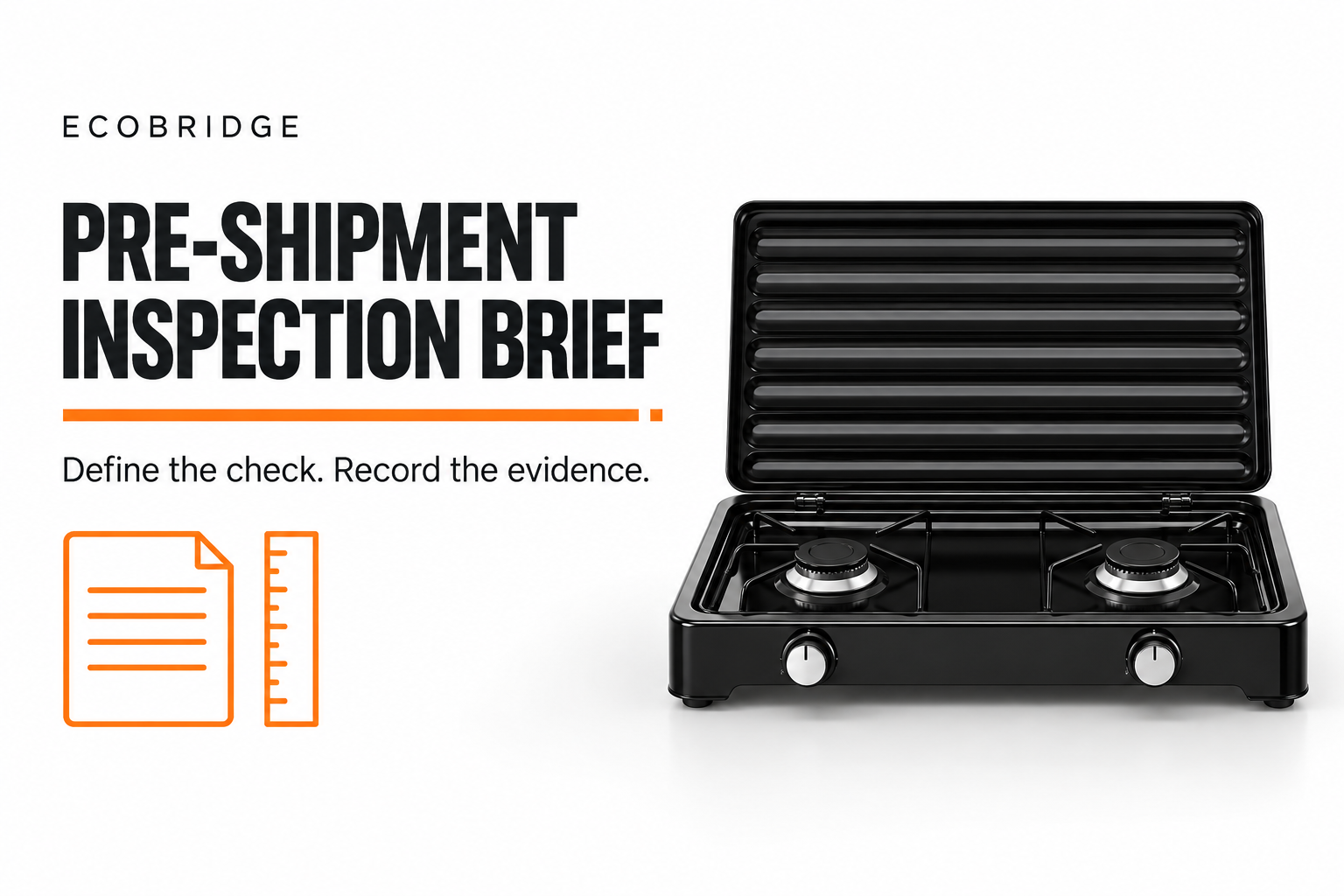
Before booking a gas stove pre-shipment inspection, give the inspector a version-controlled brief that identifies the exact order, the approved references, the checks to perform and the evidence to return. A request to “check quality” leaves too much room for different interpretations.
The decision rule is simple: every acceptance decision needs an agreed requirement, an identifiable inspected item and a recorded result. If the model, measurement method or acceptance criterion is unresolved, record the gap and obtain a written decision before treating that check as passed.
This guide helps importers, distributors and private-label buyers write that brief. An ECOBRIDGE catalog comparison between Models 6012L (75) and 6012 (90) shows why burner count and a similar photograph are insufficient inspection instructions. The article provides a document register, check matrix, evidence sequence and copy-ready supplier brief. It does not report an inspection of either model or prescribe technical test limits.
Quick Answers for Buyers
| Pergunta do comprador | Resposta prática |
|---|---|
| What should the brief identify? | The PO, lot, complete model and variant, destination, approved document revisions, inspection scope and release authority. |
| Can the catalog be the acceptance standard? | Use it to identify questions. Convert relevant entries into a signed order specification with agreed methods and tolerances. |
| Who sets sampling and defect rules? | The buyer and inspection provider should agree them before the visit, with the applicable technical requirements reviewed by qualified parties. |
| What if a check cannot be completed? | Record it as not checked, explain why and refer it to the named decision owner. Do not convert missing evidence into a pass. |
| Does a satisfactory inspection report authorize shipment? | Only if the agreed release process says so. Keep the inspection result, corrective-action closure and shipment authorization traceable. |
1. Define the Decision Before Listing the Checks
Separate inspection from supplier selection
A supplier assessment asks whether a factory is a suitable partner. A pre-shipment brief asks what must be checked on an identified order before a shipment decision. These are related but different tasks. Factory presentations, system certificates or a previous successful order do not replace records for the lot now waiting for inspection.
Start with one sentence: “Inspect PO [reference], lot [reference], complete model/variant [reference], against the attached approved document register, and return the stated records to [decision owner].” Add the location, contact, planned date, expected quantity and what the supplier must have ready.
State what the visit can establish
Distinguish document review, visible workmanship checks, dimensional checks, packing checks and any separately authorized technical work. Define exclusions as clearly as inclusions. A visual check of a label is different from verifying its technical content; a photograph of a burner does not establish its rated performance.
For the broader purchasing framework, use the Guia de controlo de qualidade de fogões a gás. Keep this brief focused on instructions and evidence for the specific inspection assignment.
2. Lock the Document Register Before the Visit
Send the same reference pack to the supplier and inspection provider. A file name alone is weak revision control: “final” can describe several different attachments. Record a document identifier, revision, approval date, approver and the aspect of the product it controls.
| Reference | Record in the brief | Question it resolves |
|---|---|---|
| PO and SKU schedule | PO number, model/variant, quantity and approved amendments | Which goods belong to the inspection lot? |
| Order specification or drawing | Identifier, revision, measurement method and agreed limits | What is the acceptance basis for each characteristic? |
| Approved sample record | Sample ID, approval scope, dated photos and storage location | Which visible features were actually approved? |
| Labels, manual and artwork | Exact model, language, destination inputs and approved print versions | Which files must match the packed unit? |
| Packing specification | Unit pack, carton quantity, markings and approved arrangement | What must be inside and outside the carton? |
| Inspection protocol | Scope, sampling, defect definitions, methods and escalation owner | How are observations turned into reportable decisions? |
Resolve conflicting references explicitly
Do not ask an inspector to choose between two drawings or infer which email changed the order. Obtain a written resolution identifying the affected characteristic and replacement reference. Retain the superseded document in the project history while clearly marking which revision is active for this lot.
Utilize o Guia de fichas técnicas de fogões a gás to organize those fields before inspection. A missing tolerance or ambiguous measurement datum is a preparation issue; discovering it during the visit can leave the result undecidable.
3. A Real ECOBRIDGE Example: Two Burners Do Not Identify the Variant
The ECOBRIDGE April 2026 gas stove catalog, PDF page 9, lists both 6012L (75) and 6012 (90) as two-burner gas cookers. Their documented product footprints match, but their listed heights and packing dimensions differ.
| Catalog field | 6012L (75) | 6012 (90) | Instruction to resolve before inspection |
|---|---|---|---|
| Product description | 2-Burner Gas Cooker | 2-Burner Gas Cooker | Record the complete identifier; “two-burner stove” cannot distinguish them. |
| Product size, as listed | 600 × 330 × 75 mm | 600 × 330 × 90 mm | Confirm the ordered construction, measurement condition and approved tolerance. |
| Packing size, as listed | 400 × 366 × 625 mm | 405 × 400 × 625 mm | Confirm dimension order, carton specification and measurement method for the actual shipment. |
| PCS/CTN, as listed | 4 | 4 | Verify the approved packing arrangement; the same carton count does not establish the same pack. |
What the comparison establishes
The listed height differs by 15 mm even though both entries share the 600 × 330 mm footprint and four-piece carton count. The practical insight is that a footprint check and quantity check alone could leave variant identity unresolved. Add the full model reference and the agreed height measurement condition to the brief.
These are documented catalog values, not measurements from a production lot, agreed tolerances or evidence of interchangeability. The catalog does not establish which configuration a buyer ordered. Do not infer gas suitability, compliance coverage, burner output or the meaning of a model suffix from this dimensional comparison.
Turn the example into a controlled check
For an order using either platform, request a signed configuration sheet and a marked drawing showing the measurement points. Ask whether feet, pan supports and lid position are included in each measurement. Record the supplier’s answer as a proposed method, then obtain agreement before the inspector uses it.
Source status matters: the dimensions above are documented; actual lot identity and measured results remain pending until inspection. If the approved order reference differs from the catalog, log that difference and its approval rather than silently replacing one value.
4. Build a Check Matrix That Produces Usable Evidence
Give each check a reference number. That number should appear in the brief, the report and the photo register. It allows a purchasing manager to connect a finding to the requirement it affects without searching a long email chain.
| Check area | Required reference | Evidence to request | If the basis is missing |
|---|---|---|---|
| Lot and variant identity | PO, SKU schedule and approved configuration | Lot list, unit/carton identifiers and matching photos | Escalate unidentified or mixed goods before applying results to the order. |
| Dimensions and visible assembly | Drawing, agreed method and approved sample scope | Measurement record, instrument identification and contextual photos | Record observations without inventing a tolerance or approval. |
| Labels and manual | Approved print files and document register | Legible photographs, revision comparison and packed-content record | Refer technical or language questions to the designated reviewer. |
| Embalagem e quantidades | Packing specification and quantity schedule | Carton-to-unit trace, contents count and pack arrangement photos | Request the missing packing decision before marking conformity. |
| Authorized technical checks | Agreed protocol and applicable technical criteria | Method, conditions, equipment and results within the authorized scope | Stop that check and refer it to qualified technical personnel. |
| Open findings | Finding log and agreed disposition process | Correction evidence, responsible person and closure approval | Keep the finding open; document the resulting release decision. |
Use precise result labels
Separate “conforms to reference,” “does not conform,” “not checked” and “awaiting clarification.” If the provider uses different status terms, agree a mapping. “Not applicable” needs a reason; it should not hide an omitted check. Report the actual observation even when a commercial decision is still pending.
Keep measured values separate from conclusions. A result such as “height measured [value] using method M-03” remains useful after a tolerance question is resolved. “Size OK” without the value, item identity or reference gives the buyer little to review.
5. Agree Sampling and Defect Rules Before the Inspector Arrives
Define the lot and how items are selected
State whether the assignment covers one model, several variants or separate lots. Record the available quantity, packing status and any excluded goods. Ask the inspection provider to propose a selection method suited to that scope, then agree how selected cartons and units will be identified in the report.
A preselected display unit is not automatically representative of the offered lot. Require the report to explain how samples were selected and any access restrictions. If only part of the order is available, record the inspected population and avoid applying its conclusion to unavailable goods.
Make defect definitions order-specific
Agree defect categories, examples and acceptance rules with the buyer, supplier and inspection provider before the visit. Do not borrow a numerical sampling limit or a cosmetic threshold from an unrelated product merely because it appears in a checklist. A photograph can illustrate an agreed defect definition, but it cannot establish a universal limit.
Describe how repeated findings, mixed variants, missing references and unperformed checks will be escalated. Record who can approve a concession and what evidence that decision requires. Technical or compliance concerns must go to the appropriate qualified reviewer rather than being closed through an informal purchasing comment.
6. Keep Technical Work Within an Approved Protocol
The inspection brief should identify which technical checks are authorized, who performs them and the applicable reference. It should not invent a leakage limit, flame-failure time, pressure setting or test duration. Neither a catalog photo nor a general factory statement provides those criteria.
Ask for the protocol, not a demonstration
Where technical testing is included, request the agreed method, applicable conditions, equipment identification, relevant calibration status, result format and responsibility for interpreting exceptions. Qualified personnel should determine the suitability of the setup and procedures for the actual product and market.
A video of a stove operating can document what is visible in that recording. It does not, by itself, demonstrate conformity with every applicable requirement. The report must state the scope and limitations of any demonstration, measurement or document review.
Separate conformity evidence from shipment inspection
Product compliance documentation and a pre-shipment inspection serve different purposes. Define the required technical and market evidence during product development and approval. At shipment stage, identify which documents must match the ordered variant and which checks the inspection assignment can actually perform. Do not present a routine inspection report as a replacement certificate.
7. Require a Carton-to-Unit Photo Sequence
A useful photo set lets a reviewer follow the inspected item from its place in the offered lot to its unpacked condition. Ask for a register containing photo ID, check reference, lot, carton, unit and a short factual description. Preserve original files alongside any annotated copies.
Before opening
Record the offered goods, selection location, selected carton identifier, external markings and visible carton condition. Show enough context to connect close-up photographs to a particular carton. Keep quantities and identifiers consistent with the selection record.
During unpacking and checking
Photograph the opened packing arrangement before moving its contents, then the identified unit, supplied loose items, manual and labels. For dimensional checks, show the measurement points and readable result where practicable. For visible findings, capture an overall view and a close-up with a clear reference.
After checking
Record any affected unit’s disposition and how opened packs are restored or segregated. Keep photographs of corrections linked to the original finding. A new photo of a different unit cannot establish that the identified affected item was corrected.
For the packing arrangement itself, use the separate transport packaging approval guide. The inspection brief should refer to that approved pack, rather than designing a new one during the visit.
8. Define the Report and Exception Workflow
Request a report that states the inspection date, location, personnel, offered quantity, inspected scope, reference revisions, methods, results and limitations. Every nonconformity should identify the affected requirement and items, with supporting photographs or measurements.
Separate three decisions
First, record the finding. Second, decide its disposition: correction, further review or another agreed action. Third, record shipment authorization through the named release process. Keeping those steps distinct prevents a supplier correction email from being mistaken for a buyer’s release instruction.
Where correction or reinspection is required, name the responsible person, target date and evidence needed for closure. State whether the follow-up reviews documents, selected corrected items or a newly defined lot. Do not describe a follow-up as a complete reinspection unless its scope supports that statement.
Use a written open-point register
For each issue, retain the finding ID, requirement, observation, affected quantity, current status, owner, proposed action, closure evidence and approving party. Pending questions should remain visible in the shipment decision. A clean summary page must not erase unresolved exceptions in the detailed report.
9. Copy-Ready Gas Stove Pre-Shipment Inspection Brief
Complete the bracketed fields and attach the actual references before sending this template. It is a buyer coordination tool, not a technical test method or a statement that ECOBRIDGE has accepted the proposed scope.
Subject: Inspection brief approval — PO [number], model/variant [complete reference]
Please review the proposed inspection of [lot/quantity] at [location] on [date]. The decision owner is [name/role]. The scope covers [models and checks]; exclusions are [items and reasons].
Attached is reference register [revision/date], including the PO, approved specification/drawing, sample record, labels, manual, artwork and packing specification. Please identify any unavailable, inconsistent or superseded reference before the visit.
For the 6012-family dimensional check, confirm the complete ordered identifier, the drawing revision, the height measurement condition and agreed tolerance. Confirm the carton dimension order, packing arrangement and quantity basis. Catalog entries are reference inputs, not automatically the order acceptance criteria.
Please confirm the offered quantity and packing status, proposed sample-selection method, defect definitions, acceptance rules and report format. Identify the qualified personnel and agreed protocol for any authorized technical work. No unagreed technical limits are implied by this brief.
Return the check matrix with actual results, carton/unit traceability, photo register and open-point log. Mark unperformed checks and unresolved criteria explicitly. Send corrections and follow-up evidence against the original finding IDs.
Shipment authorization will follow [named release process]. Please acknowledge the scope, references, readiness and outstanding decisions by [date].
Common Brief-Writing Mistakes
- Using only a product photo. Add the complete variant and approved reference revisions.
- Checking only footprint and burner count. The 6012 catalog example shows why those fields can miss a documented height distinction.
- Treating catalog numbers as tolerances. Obtain the actual order criteria and measurement method.
- Writing “all tests passed.” List what was performed, its basis and what remains outside scope.
- Hiding unavailable checks. Keep not-checked items and restrictions visible.
- Accepting correction photos without traceability. Connect each closure record to the original affected item and finding.
- Confusing a report with release approval. Name who authorizes shipment and retain that decision.
Final Decision: Is the Brief Ready to Send?
Send the brief when both parties can identify the same lot, retrieve the same approved references, understand the agreed checks and return evidence that supports a shipment decision. If any of those links is missing, resolve it before the visit or explicitly define the resulting limitation.
The ECOBRIDGE 6012-family example supplies a concrete reminder: matching burner count, footprint and carton quantity does not settle variant identity. A useful brief turns that ambiguity into a named check with an approved reference, a measurement method and a decision owner.
Prepare Your Inspection Scope With ECOBRIDGE
Contacte a ECOBRIDGE with your PO reference or proposed model, complete variant, destination, quantity, packing requirements and planned inspection scope. For a 6012L (75) or 6012 (90) inquiry, request the current signed configuration sheet, dimensional drawing, packing specification and document revisions before finalizing the brief. Include your inspection provider’s proposed methods and unresolved fields so the supplier can respond to specific requirements.
Source note: Product comparisons use the ECOBRIDGE Gas Stove catalog, version 2026-04, PDF page 9 (601 Series). Values are catalog entries, not an inspection report, approved order specification or compliance conclusion. Confirm the current documents for the actual order.
 English
 Spanish
 Portuguese
 French
 Dutch
 Bengali
 Russian
 Arabic