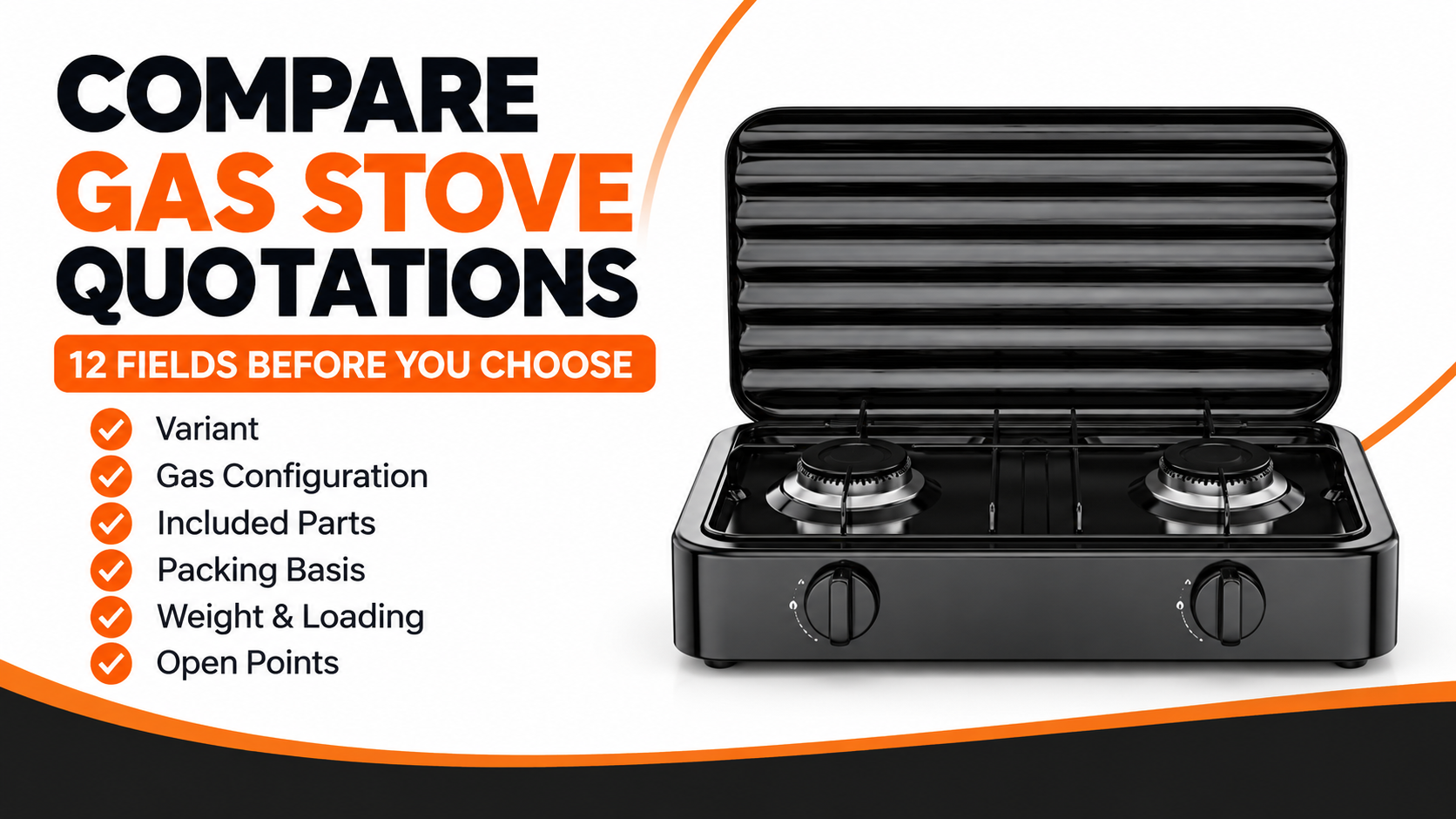
A low unit price can become an expensive purchasing decision when two gas stove quotations describe different products. One supplier may include a lid, adapter, instruction manual and reinforced carton, while another may price only the basic appliance. A quotation can also use an incomplete model name, an unconfirmed gas configuration or packing figures taken from a similar product.
For an importer, distributor or private-label buyer, the first task is to make every supplier quote the same requirement. Only then can price, packing, documentation and commercial terms be compared without hiding differences inside the quotation.
This guide gives buyers a 12-field comparison method, a quotation-normalization worksheet, an open-point register and a copy-ready supplier email. A first-party ECOBRIDGE example later in the article shows why two products with the same listed carton size and carton quantity can still require separate quotations.
গ্যাস স্টোভ আমদানিকারকদের জন্য দ্রুত উত্তর
| ক্রেতার প্রশ্ন | দ্রুত উত্তর |
|---|---|
| What makes two gas stove quotations comparable? | Both must cover the same product identity, destination, gas configuration, included parts, packaging basis, documents, quantity and commercial scope. |
| Should the lowest unit price win? | No. A lower figure may exclude parts, packing, artwork, documents or services included elsewhere. Compare the normalized scope and unresolved risks. |
| Can model numbers be compared without suffixes? | No. Record the complete supplier model and revision. A suffix may identify a different construction or option, and its meaning must be confirmed rather than guessed. |
| Are catalog packing figures enough? | They are useful reference data. The quotation should identify the final carton revision, units per carton, weight basis and whether loading quantities are estimates or approved order data. |
| What should stop quotation approval? | Hold approval when product identity, gas configuration, major inclusions, packaging basis, document scope or open cost assumptions are still unclear. |
The Buying Decision: Are the Quotations Truly Comparable?
The useful decision is not “Which supplier entered the smallest number?” It is “Which quotation gives the clearest, most complete and most commercially suitable offer for the same approved requirement?” A quotation is ready for comparison when a buyer can trace its price to an exact product version and see every material inclusion, exclusion, assumption and pending confirmation.
Decision rule: do not rank quotations until all suppliers have answered the same 12 fields and every difference has been priced, removed or recorded as an open condition.
This method prevents a common sourcing error: comparing a complete offer with an incomplete one. It also gives technical, purchasing and logistics teams one document to review instead of separate email threads with different assumptions.
1. Freeze One Comparison Baseline Before Requesting Prices
Define the buyer requirement first
Start with one controlled requirement sheet. It should identify the intended appliance format, burner and control arrangement, destination, required gas information, finish, packaging, branding and documents. If a field is unknown, label it “supplier to confirm” and state what evidence is expected.
The baseline can link to the গ্যাস চুলার স্পেসিফিকেশন শীট, approved photographs and packaging brief. Give the package a buyer reference and revision date so each supplier can quote the same version.
Separate required, optional and pending fields
- Required: the quotation must include this item or configuration.
- Optional: the supplier should price it separately so the buyer can compare choices.
- Pending confirmation: the buyer needs technical or market evidence before release.
- Excluded: the buyer has intentionally removed the item from this comparison.
This status system prevents an optional feature from being treated as a missing requirement and prevents an unresolved technical point from disappearing into the unit price.
Use one quotation currency and Incoterm basis
Ask every supplier to state the currency, Incoterm, named place and quotation validity. Do not convert currencies or add logistics assumptions until the basis is clear. This article does not publish ECOBRIDGE project prices because price depends on the exact configuration, quantity, packing and commercial terms of the current request.
2. Compare the 12 Fields That Define the Real Offer
| Field | What the supplier should state | Why it changes the comparison |
|---|---|---|
| 1. Complete model identity | Model, suffix, buyer SKU and quotation revision | Similar names can describe different versions. |
| 2. Appliance configuration | Tabletop, built-in or freestanding form; burner and control arrangement | The physical product and market position may differ. |
| 3. Gas basis | Intended fuel, nominal pressure and connection basis, subject to project confirmation | Gas-related components, labels and documents may change. |
| 4. Ignition and safety scope | Quoted ignition, valves and any selected safety-related options | Do not assume functions from a photograph or family name. |
| 5. Materials and visible finish | Body, lid, pan support, burner parts, knob and color description | Material and finish differences affect cost and sample approval. |
| 6. Included parts | Adapter, hose-related items where applicable, manuals and other packed contents | An incomplete inclusion list makes unit prices misleading. |
| 7. Product evidence | Linked specification, drawing, photo set or sample ID and revision | The quote needs an identifiable product reference. |
| 8. Product dimensions | Width, depth and height with units and measurement condition | Dimensions affect shelf fit, product positioning and packing. |
| 9. Retail and master packing | Retail box, inner protection, master carton and units per carton | Packing scope affects print, protection and logistics. |
| 10. Weight and loading basis | N.W./G.W., whether per unit or carton, and loading estimate assumptions | Freight and handling comparisons depend on the same basis. |
| 11. Branding and documents | Rating plate, manual, artwork, barcode and requested technical documents | Private-label deliverables may be excluded from a headline price. |
| 12. Commercial conditions | Quantity basis, MOQ status, sample cost, tooling if any, payment, lead-time basis, validity and exclusions | Commercial assumptions can outweigh a small unit-price difference. |
Record the complete identity, not a short sales name
A model number alone is insufficient when the supplier also uses suffixes, market versions or option codes. Ask the supplier to explain which characters are part of the controlled model and which describe a selectable option. Keep this identity consistent across the quotation, sample, label, artwork and purchase order.
Ask for measurable scope
Words such as “standard packing,” “normal accessories” and “common gas type” cannot support a like-for-like comparison. Replace them with named items, units, revisions and evidence. If the supplier cannot confirm a field yet, keep it open with an owner and due date.
3. First-Party Example: Why Similar Packing Does Not Prove an Equal Quotation
ECOBRIDGE reviewed its internal English gas-stove working quotation sheet on 24 September 2026. The sheet contains separate entries for Models 6002 and 6003. This internal working source is used here to demonstrate document control; it does not establish a final customer price, gas configuration, certification status or order-approved specification.
| Recorded field | Model 6002 | Model 6003 | Buyer implication |
|---|---|---|---|
| পণ্যের আকার | 58 × 28 × 5.4 | 58 × 28 × 5.4 | The working sheet records the same dimensions, but this does not prove identical construction. |
| Gift-box size | 59.5 × 7 × 33.5 | 59.5 × 7 × 33.5 | Retail-box volume appears comparable in the sheet. |
| Master-carton size | 63 × 33.5 × 59.5 | 63 × 33.5 × 59.5 | The same listed carton size does not make the products interchangeable. |
| Units per master carton | 8 | 8 | The carton quantity is aligned for this working comparison. |
| Recorded N.W./G.W. | 19.2 / 21.5 | 21.2 / 22.7 | The weight entries differ and require confirmation of units and carton basis. |
| Safety-valve diameter field | φ0.7 mm × 2 | φ0.7 mm × 2 plus φ0.5 mm × 1 | The component description differs. Do not infer function or final gas suitability without the relevant specification and review. |
The important finding is the combination of agreement and difference. The sheet records the same product size, gift box, master carton and carton quantity, while also recording different weights and a different safety-valve field. A buyer who compares only unit price and carton size could miss a real product-scope difference.
What should the buyer request next?
- Complete model and suffix confirmation for each quoted variant.
- A current specification that explains the recorded configuration.
- Confirmation that dimensions and weights use the same units and basis.
- Photos or drawings linked to each exact model.
- Separate prices only after the configuration and included parts are aligned.
This is why a first-party discrepancy is more useful than a generic purchasing tip: it identifies the exact fields that must be closed before a commercial comparison is reliable.
4. Normalize Product Configuration Before Comparing Unit Price
Create an inclusion and exclusion matrix
| আইটেম | Buyer requirement | সরবরাাহকারী A | সরবরাхকারী বি | Action |
|---|---|---|---|---|
| Lid and hinge set | [required / optional] | [included / excluded / unclear] | [included / excluded / unclear] | [confirm or price separately] |
| Pan supports and burner parts | [exact description] | [প্রবেশ] | [প্রবেশ] | [compare material and quantity] |
| Knobs and markings | [exact version] | [প্রবেশ] | [প্রবেশ] | [link to sample or drawing] |
| Adapter and packed accessories | [list] | [প্রবেশ] | [প্রবেশ] | [confirm destination relevance] |
| Manual, label and artwork | [language and revision] | [প্রবেশ] | [প্রবেশ] | [state included service scope] |
| Retail and master carton | [packing requirement] | [প্রবেশ] | [প্রবেশ] | [confirm final revision] |
Price options separately
When a feature is not mandatory, ask for a base quotation and a separate option line. This makes the commercial effect visible without creating parallel product descriptions inside one price. Each option should state whether it changes the model identity, sample, packing, weight, loading, label or documents.
Link the quotation to the approved sample
If a physical unit has been reviewed, record its sample ID in the quotation. Use the golden sample approval method to define what the sample controls and what still needs separate evidence. “Same as sample” without an identifiable sample and exception list is not a complete commercial scope.
5. Normalize Packaging and Logistics Basis
Use the same unit of comparison
Record product size, retail-box size and master-carton size in one agreed unit. State the dimension order. Do not silently compare centimetres with millimetres or per-unit weight with master-carton weight.
Check carton quantity before using loading figures
A container loading number is meaningful only when it is tied to the final carton dimensions, carton quantity, packing orientation, container type and any pallet decision. Treat catalog loading data as an estimate until the final packing configuration is approved.
Calculate comparable logistics measures
- Master-carton volume: length × width × height, converted to cubic metres.
- Packaging volume per stove: master-carton volume ÷ units per carton.
- Gross weight per stove: master-carton gross weight ÷ units per carton, only when the weight basis is confirmed.
- Freight per stove: confirmed container freight ÷ confirmed loaded quantity.
These calculations help explain why a higher factory price can still produce a lower landed cost. They should use current project data rather than generic assumptions.
6. Convert Every Open Point Into a Price Condition
Do not leave unanswered questions in scattered emails. Put them beside the quotation and state whether the answer can change price, sample, documentation, packing or delivery planning.
| Open point | বর্তমান অবস্থা | Possible commercial effect | Evidence required | Owner / due date |
|---|---|---|---|---|
| Exact gas configuration | Pending confirmation | May change components, labels and documents | Project specification and applicable records | [প্রবেশ] |
| Final packed contents | Supplier list incomplete | May change unit scope and carton weight | Contents list and packing photo | [প্রবেশ] |
| Artwork languages | Buyer input pending | May affect artwork service and approval time | Language brief and controlled files | [প্রবেশ] |
| Carton revision | Working value only | May change freight and loading | Final dieline, dimensions and packing trial | [প্রবেশ] |
| Requested documents | Scope not agreed | May affect feasibility, cost or timing | Destination-specific document list | [প্রবেশ] |
A quotation can remain provisional while these points are open, but it should not be presented as a final like-for-like offer.
7. Check the Evidence Behind Each Quoted Claim
Use a practical evidence hierarchy
- Order-specific controlled document: the strongest reference when it is current and approved.
- Measured or inspected sample record: useful for the exact identified unit and the checks actually completed.
- Current drawing, component record or packing trial: supports the fields it specifically covers.
- Catalog or product page: useful for selection, but it may not contain the final order configuration.
- Marketing image or informal message: a lead for clarification, not sufficient proof of every quoted claim.
Separate documented facts from sales wording
If a quotation says “high quality,” “export standard” or “certified,” ask what document, standard, test report or approved specification supports the statement and whether it applies to the exact quoted model and destination. Do not add unsupported claims to the comparison score.
Control changes after quotation
A price should not remain attached to an outdated configuration. If a burner, valve, knob, pan support, finish, carton or document changes after quotation, use a written component change approval to decide whether the price and evidence must be revised.
8. Build a Landed-Cost Comparison Without Inventing Numbers
| Cost line | সরবরাাহকারী A | সরবরাхকারী বি | Source / condition |
|---|---|---|---|
| Quoted unit price | [প্রবেশ] | [প্রবেশ] | Same currency and Incoterm |
| Required options not included | [প্রবেশ] | [প্রবেশ] | Approved option list |
| Packaging or artwork cost | [প্রবেশ] | [প্রবেশ] | Only confirmed project charges |
| Inspection or testing arranged by buyer | [প্রবেশ] | [প্রবেশ] | Use actual quotations where applicable |
| Freight per stove | [প্রবেশ] | [প্রবেশ] | Confirmed loading and freight basis |
| Duty, tax and destination costs | [প্রবেশ] | [প্রবেশ] | Buyer or qualified adviser confirms |
| Comparable landed-cost estimate | [calculate] | [calculate] | Show assumptions and date |
Keep uncertain values blank or labelled as estimates. Do not replace missing data with a convenient industry percentage. The purpose of the worksheet is to reveal uncertainty before a purchase decision, not to hide it inside a calculated total.
9. Review Technical and Commercial Results Separately
Technical gate
First decide whether each quotation matches the controlled requirement. A technically non-comparable offer should be returned for clarification before it enters the price ranking.
Commercial review
For offers that pass the technical gate, compare normalized unit price, packing, documentation, commercial terms and confirmed landed-cost inputs. Keep payment, lead time, warranty and MOQ exactly as quoted. ECOBRIDGE terms should be confirmed for the current project rather than copied from another order.
Decision record
Record the selected offer, alternatives considered, open conditions, approval names and quotation revision. This creates a traceable bridge from RFQ to sample, purchase order and inspection.
10. Common Quotation Comparison Mistakes
- Ranking suppliers before confirming the exact model and suffix.
- Comparing a complete offer with a base appliance price.
- Assuming photographs prove gas configuration, materials or included parts.
- Using catalog loading quantities as final order data.
- Ignoring whether weights are per unit or per carton.
- Converting currencies without recording the rate and date.
- Mixing EXW, FOB and other Incoterm bases in one price column.
- Treating MOQ, lead time or warranty from an old project as a current promise.
- Approving a quotation while technical documents and artwork scope remain open.
- Failing to revise price after an approved product or packaging change.
11. Copy-Ready Email for Comparable Gas Stove Quotations
Subject: Please revise quotation to the controlled comparison sheet
Hello [supplier],
Thank you for quotation [number / revision]. Before commercial comparison, please return a revised offer for buyer reference [RFQ reference and revision].
Please confirm the complete model and suffix, appliance configuration, intended fuel and pressure basis, ignition and safety scope, body and visible materials, included parts, linked sample or specification revision, product dimensions, retail and master packing, units per carton, N.W./G.W. basis, loading estimate assumptions, branding and document scope.
Please list every exclusion and price optional features separately. Mark unconfirmed fields as pending rather than using a similar model. State currency, Incoterm and named place, quantity basis, quotation validity, MOQ status, sample or tooling charges if applicable, payment terms and lead-time basis.
Please also explain any difference between your quotation, catalog page, sample and packing data. We will compare prices after the technical and packaging scope is aligned.
Regards,
[buyer / company]
12. Frequently Asked Questions
How many supplier quotations should an importer compare?
There is no universal number. Compare enough qualified offers to understand the market and alternatives, while keeping the requirement and review capacity controlled. Three incomplete quotations are not automatically better than two fully comparable ones.
Should buyers ask every supplier to use the same quotation template?
Yes, when possible. A shared template reduces missing fields and makes differences visible. Suppliers can attach their standard quotation, but the controlled comparison sheet should contain the fields needed for the buyer decision.
Can an importer negotiate price before closing technical points?
Discussion can begin, but a final price comparison should wait until material scope differences are resolved. Otherwise, a discount may apply to a configuration that the buyer cannot approve.
What if a supplier refuses to identify exclusions?
Treat the offer as incomplete. Ask for written clarification and record the issue in the open-point register. Do not assume an item is included because it appears in a photo or another supplier’s quotation.
Does the quotation approve certification or market compliance?
No. The quotation can state the proposed document scope, while the buyer should verify applicable destination requirements and exact model coverage separately. Use the গ্যাস স্টোভ সার্টিফিকেশন গাইড to organize that review.
Final Answer: Which Quotation Should an Importer Choose?
Choose from quotations that first pass the same technical and packaging baseline. The preferred offer should identify the exact product, close material open points, show inclusions and exclusions, link claims to evidence and state its commercial basis clearly. Then compare normalized price and landed-cost inputs.
The lowest visible unit price is not a reliable decision when the product, packing or document scope differs. A controlled quotation comparison turns those hidden differences into fields that purchasing can verify, price and approve.
Request a Comparable Gas Stove Quotation from ECOBRIDGE
Send ECOBRIDGE your destination, intended fuel and pressure basis, product format, burner and control requirement, buyer SKU, finish, packed contents, branding, packaging, document list, estimated quantity, Incoterm and target timing. Attach your comparison template or ask us to return the 12 fields in this guide.
For a useful response, identify which items are mandatory, optional or pending confirmation. ECOBRIDGE can then prepare a quotation tied to the requested variant and list open points instead of filling gaps with unsupported assumptions. Request a controlled B2B quotation.
 English
  Spanish
  Portuguese
  French
  Dutch
Dutch  Bengali
  Russian
  Arabic