
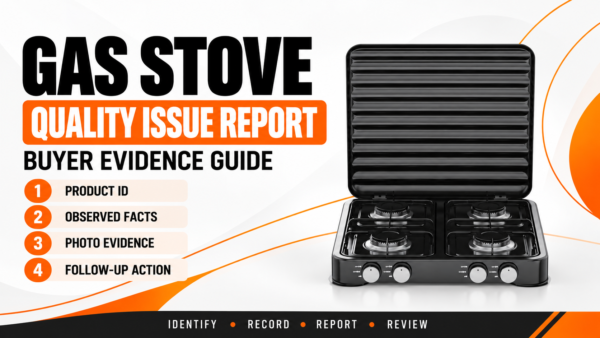
গ্যাস স্টোভের গুণগত মান সমস্যা প্রতিবেদন: ক্রেতার প্রমাণ নির্দেশিকা
When an importer finds a possible gas stove quality issue, the first useful supplier message identifies the affected product, the requirement being questioned, the observed condition and the evidence still missing. A close-up photograph may start the conversation. It rarely establishes the correct variant, the size of the affected population or the cause on its own. Use this decision rule: separate the observed condition from the proposed explanation, connect every finding to an identifiable unit and an approved requirement, and keep the case open until the agreed disposition and corrective-action evidence have been reviewed. If the reference itself is uncertain, resolve that uncertainty before calling the product nonconforming. This guide gives importers, distributors and wholesale purchasing teams a reusable gas stove quality issue report and supplier response workflow. A real catalog comparison between Models 6004 and 6004H shows why an apparently straightforward dimensional complaint needs a precise model reference. No actual defect, customer complaint or investigation result is reported here. Quick Answers for Buyers On a small screen, scroll each table sideways to read all columns. Buyer question Working answer Evidence to retain What belongs in the first report? Order and variant identity, observed condition, requirement reference, known quantities and an evidence index. Case register and original files. Does a photograph prove the cause? No. Record what it shows separately from hypotheses about manufacturing, transport or handling. Context images, chronology and investigation response. Can a catalog dimension define a defect? It can raise a question. Verify the exact order-approved variant, measurement method and acceptance requirement. Approved specification and measurement record. How many units are affected? State inspected and observed counts first. Keep uninspected stock separate from confirmed affected units. Unit or carton register with a clear denominator. When is the case closed? When the named decision owner accepts the agreed





 English
 Spanish
 Portuguese
 French
 Dutch
 Bengali
 Russian
 Arabic